Discover A Real Homeschool Day in the Life 180 (Adventure Behind the Scenes)
If you’ve ever Googled ‘A Real Homeschool Day in the Life’ and come back with photos of a perfectly organized schoolroom, color-coded binders, and children in matching outfits sitting at tiny desks…
Our day looks nothing like that.
On a typical day, we do about 20 to 30 minutes of what you might call traditional schoolwork — focused practice in reading, writing, or math. That’s it. The rest of our day is built around read-alouds, time with our homeschool community, real-world learning, so much outside time and the kind of unhurried afternoon that my child’s nervous system(and ours) genuinely needs.
I’m sharing our actual day here because I think too many new homeschool families are afraid to do less. They’re trying to replicate a six-hour school day at home and are burning out by November. And the research — and the thousands of thriving homeschool families I’ve encountered — consistently shows that you don’t need to.
Less is often more. Here’s what that actually looks like.
📌 A Note on Our Approach
We lean towards unschooling and eclectic DIY — which means we trust our child’s natural curiosity
to drive a lot of learning, and we only impose formal structure in the areas where we’ve decided explicit practice matters: reading, writing, and math.
Science and social studies happen through books we read aloud, conversations, real-life
experiences, and community. Not through a curriculum.
This approach is legal in South Carolina under all three homeschool options.
It’s also, in our experience, remarkably effective.
📋 Our Day at a Glance
6:45-9:00: Wake up, read-aloud, breakfast, get ready for the day, slow start
9:00am: Head to group (on group days) OR focused bookwork at home (home days)
Group days(3-4 days per week) : Out until ~2:00 or 3:00pm
Home days: 20–30 min bookwork + free morning, lunch at 12:00pm
~1:00–3:00pm: downtime or home outside backyard time
~3:30–4:30pm: Playdough Time
4:45pm: Dinner
5:15pm: Bath
6:00pm: Stories/Songs/Bedtime Routine
7:00pm: Bed
The Morning: Slow on Purpose
We do not start the day with structured school. We start the day like humans.
There’s breakfast, there’s whatever conversation comes up naturally, there’s time to wake up at a pace that doesn’t involve stress. My child is young enough that a rushed morning does real damage to the rest of the day — anxious transitions make everything harder, including learning.
So we protect the slow morning. This is not laziness. It’s neurologically sound.
6:45–7:30am Wake up & Stories
No alarm. We don’t talk about school yet. We talk about whatever comes up — dreams, questions, what’s happening outside. We read aloud to one another. This connection is not a warm-up to learning. It IS learning.
7:30–8:15am Breakfast & Get Ready for the Day
Breakfast together at the table, always. Talk about what our plans are for the day. Teeth brushing, changing clothes, clean-up.
8:15–9:00am Flextime
This is our transition into the school day. If we have an outing planned, we might skip standard “bookwork” all together, or stick to something quick and simple like a worksheet. If no outing, we might head to the backyard for some morning outside time, or do a bit of “free play” where our son chooses what he spends his time on.
Read-Alouds: The Anchor of Our Day
Read-alouds are the backbone of our homeschool. We do them 2-3 times a day(both my husband and I read to our son, AND our son reads to us), totaling somewhere around 1.5 hours, every day — even days we don’t “count” in our 180. If I had to name one thing that is doing the most educational work in our home, it’s this.
Our first read-aloud session of the day usually happens within 15 minutes of our son waking — before we do generally anything. We sit together with whatever we’re currently reading and we just… read.
What we cover through read-alouds:
- History — we’re almost always reading something historical, whether it’s a picture book, a narrative history, or a chapter book set in a different time period
- Science — nature books, books about animals, books about how things work, books about the human body, books about space
- Social studies — stories set in different communities, countries, and cultures
- Vocabulary — without any worksheets or drills, just the natural exposure of hearing beautiful, varied language
- Love of reading — the most important thing we’re building
📚 Why Read-Alouds Do So Much Heavy Lifting
When a child is read to aloud — especially with expression and discussion — they are building vocabulary, comprehension, world knowledge, listening skills, and a relationship with books that no workbook can replicate.
Jim Trelease’s research on the read-aloud has been showing this for decades. Reading aloud to children beyond picture-book age (5, 8, 11, 14) is one of the highest-return educational investments a parent can make.
It also doesn’t feel like school. That matters.
Group Days: Out by 9-9:30am, Home by 2 or 3pm
On group days — which happen regularly throughout our week — we head out around 9 or 9:30am to meet our group. We’re usually back home between 2 and 3pm. We are not in any official co-op’s, just nature/hiking meet-up groups and various field trips. For now we stick to the free, mostly play based experiences. I do not find formal educational based co-ops beneficial until around age 10.
These are not just supplemental days, however. These are full, rich, self-led educational and social days. My child is learning alongside other children, navigating real relationships, participating in activities led by adults who aren’t me, or making up his own, and practicing the kind of independence that only happens when you’re not in your own house.
Group days are also where science experiments happen, where engineering projects happen, where my child does things they couldn’t do at home. The enrichment groups do the work I can’t replicate at home.
💡 On Co-op Days, We Don’t ‘Do School’ After
When we get home from a group outing, we’re done. We enjoy some downtime then the late afternoon
routine. There is no ‘now let’s do our bookwork’ after a full morning and afternoon out.
The group IS school. The social learning, the enrichment, the community — it counts.
Insisting on formal bookwork afterward is the fastest way to make everyone miserable.
Home Days: 20–30 Minutes of Focused Work
On days we’re home, we do our focused work — reading, writing, or math — for about 20 to 30 minutes. That’s the whole formal academic block of our day.
I want to sit with that for a moment because I know it sounds too short. Here’s why it works:
- One-on-one instruction is faster than classroom instruction. I’m not waiting for 25 kids to catch up. I’m working with my specific child on exactly what they need right now.
- We only do three subjects formally. Reading, writing, math. That’s it. Everything else is absorbed through living.
- We stop when the work is done, not when the clock says so. Some days 20 minutes covers what we needed. Some days we’re done in 12.
- We don’t try to do all three subjects in one day. Maybe math today, reading practice tomorrow, writing the next day. Rotating keeps the 20 minutes from ever feeling like a grind.
Why Only Reading, Writing, and Math?
Because those are the three skills that require explicit, sequential instruction to develop properly. Everything else — science, history, social studies, art, music, nature — can be absorbed through living, reading aloud, and experience without formal curriculum.
This is the core of the unschooling-informed philosophy: trust that a child who is read to constantly, who visits places, who has real conversations, who follows their curiosity, is learning science and social studies and history all day long. They don’t need a workbook to prove it.
Afternoon: Playdough, Dinner, Bath, Stories, Bed
I want to talk about our afternoon routine because I think it’s one of the most underrated parts of our homeschool day — and one of the parts most at odds with what people imagine homeschooling to look like.
3:30–4:30pm Playdough time
This is not optional and it is not a reward for finishing schoolwork. It’s a daily part of our child’s day, full stop. Fine motor development, creativity, open-ended play, sensory regulation — playdough is doing real developmental work. We put it out, we stay nearby, and we let it happen. It’s the much necessary calm to cue up a good dinner and bedtime routine.
4:45pm Dinner
Early dinner because our child is young and their body needs it. We eat together. We talk about the day. Sometimes this is the richest conversation we’ve had all day. We do rose, bud, thorn or high, low, buffalo.
5:15pm Bath
The transition into evening. Calm, predictable. Our child knows what comes next.
6:00pm Stories & Songs
Read-aloud a continuation of our chapter book. Or a stack of picture books chosen by my child. This is our last and most sacred reading time — quiet, close, no agenda.
7:00pm Bed
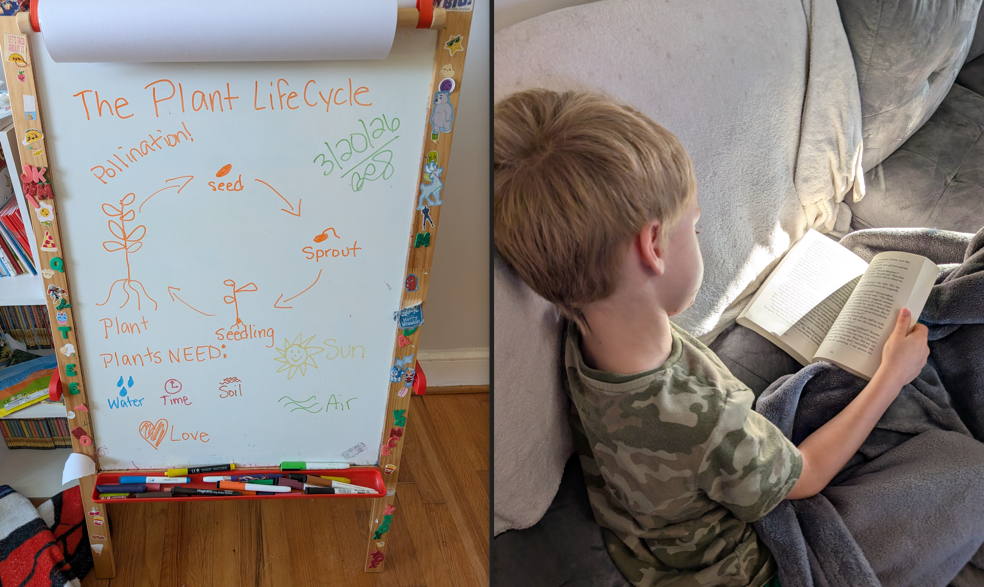
He does sustained silent reading in bed 7:00-7:30pm then goes to sleep A 7:30pm bedtime for a young child is not a punishment. It is the best parenting decision we’ve made. A well-rested child learns better, regulates better, and is kinder to be around. Protect the sleep.
📺 Occasionally: Educational TV or Videos
Some afternoons — when energy is low, when we’ve had a big morning, or when someone is coming down with something — we’ll put on something educational. PBS Kids, nature documentaries, science shows, history content, a cooking video.
This is not a failure state. It’s a tool used with intention. Generally speaking, we are primarily a screen-free household, including schoolwork. We allow up to ~2 hours per week, however.
What This Real Homeschool Day Is Actually Teaching
If you look at our day through the lens of traditional school expectations, it might look thin. No formal science lessons. No social studies workbook. No grammar drills. The ‘school’ portion is 20 minutes on a home day and zero minutes on a co-op day.
But look at it differently:
- 1-2 hours of read-alouds daily = constant exposure to vocabulary, history, science, geography, narrative structure, and ideas
- Regular group mornings = science experiments, art, social skills, enrichment led by people with different expertise than mine
- Playdough daily = fine motor development, spatial reasoning, creativity, open-ended problem solving
- Early dinner and bedtime = the sleep that makes all of the above actually stick in the brain
- Conversations woven through all of it = the real education
The research on early childhood learning is consistent: children in the 4-8 range learn best through play, read-alouds, conversation, and real-world experience. Formal academic instruction in this age range has very little advantage over a rich, language-saturated informal environment — and too much formal instruction can actually undermine intrinsic motivation and love of learning and creativity.
Our day is built on that research. It doesn’t look like school. It looks like a childhood that is also an education.
🌿 What I’d Tell a New Homeschool Parent
The most common first-year mistake is trying to do too much.
You do not need a full(6+ hour) school day at home. You do not need a curriculum for every
subject. You do not need a lesson plan for every hour.
You need read-alouds. You need presence. You need a rhythm your child can trust.
You need some connection to other homeschool families so you don’t do it alone.
Everything else is negotiable. Start with less and add if you need to.
Almost no one who homeschools this way ever needs to add more.
Does this sound anything like your family’s day? Or the day you’re hoping to build? I’d love to hear about it in the comments.
🎁 FREE DOWNLOAD: New Homeschooler’s Starter Kit
Grab our free 8-page guide — includes a curated list of Upstate SC community resources, a first-week planner, and more.
📬 FIELD NOTES — Our Weekly Newsletter
New co-op openings. Free events. Real homeschool talk. Every Thursday at 9am. Free, always.
Sign-up here!
RELATED POSTS

👩💻 AUTHOR BIO
Crystal | Founder, The Homeschool Habitat
Crystal is a homeschooling mom in Upstate South Carolina and founder of The Homeschool Habitat.
She built this site because she remembers exactly how confusing those first Google searches felt — and wanted to create the clear resource she wished she’d had.
Follow @TheHomeschoolHabitat on Pinterest and Facebook.