Montessori Homeschooling: The Complete Guide (Prepared Environment, 5 Curriculums, Materials & Daily Life)
Maria Montessori began her educational work in the slums of Rome in 1907 with a group of 50 young children who were considered ineducable. Within months, children as young as three were reading, writing, and teaching each other. By the time Montessori died in 1952, her method had spread to dozens of countries and been validated by decades of observation in schools ranging from Roman tenements to Swedish royal classrooms.
What Montessori had discovered — and what decades of subsequent research has confirmed — is that children are not passive recipients of instruction. They are active constructors of their own intelligence, equipped from birth with an ‘absorbent mind’ that takes in and organizes the world around them with extraordinary efficiency, given the right environment. The teacher’s job is not to pour information into the child; it is to prepare an environment in which the child’s natural learning drive can operate freely and effectively.
This guide covers the complete Montessori philosophy, the prepared environment, the materials that make Montessori work, the 3-hour work cycle, what a real Montessori homeschooling day looks like, curriculum options across every budget, and the guidance on who thrives in this approach and who might not.
Who Was Maria Montessori and What Did She Discover?
Maria Montessori (1870–1952) was Italy’s first female physician — a remarkable achievement in itself — who turned to education after working with children with developmental disabilities. She noticed that children labeled ‘deficient’ by the medical establishment could learn when given the right materials and the freedom to work with them at their own pace. Her insight was revolutionary: the children weren’t deficient; the educational environment was.
When she opened the Casa dei Bambini in Rome in 1907, she provided children from poor urban families with an environment full of real tools, real materials, and real work — and then stepped back. What happened astonished observers. Three-year-olds, without being taught, taught themselves to read and write. Four-year-olds worked for extended periods of intense concentration without supervision. Children cared for the environment, helped each other, and chose their own work with remarkable seriousness of purpose.
Montessori spent the rest of her life observing, refining, and articulating what she had discovered. The Montessori homeschooling method is not an invention — it is a set of observations about how children actually learn, organized into a system designed to honor those observations. Every element of Montessori homeschooling education — the low shelves, the child-sized furniture, the self-correcting materials, the uninterrupted work time, the mixed-age groupings — exists because Montessori observed something specific about child development and designed the environment accordingly.
The Absorbent Mind and Sensitive Periods
Two concepts from Montessori’s work are essential to understanding why the method is designed the way it is.
1. The Absorbent Mind (Birth to Age 6)
In the first six years of life, the child’s mind absorbs information from the environment effortlessly and unconsciously — not through deliberate learning but through being present in a rich environment. Language is the most obvious example: a child living in a household where multiple languages are spoken absorbs all of them with no instruction, no textbooks, and no effort. Montessori called this the ‘absorbent mind’ and designed her primary environment (ages 3-6) to provide the richest possible material for this absorption.
2. Sensitive Periods
Throughout childhood, children pass through periods of heightened sensitivity to particular types of learning — windows when a specific kind of learning is effortless because the mind is specifically prepared for it. Montessori identified sensitive periods for language (birth-6), movement (birth-5), order (1-3), small objects (1-4), social behavior (2.5-5), mathematics (4-6), and writing (3.5-4.5). Presenting the right material during its sensitive period produces rapid, joyful learning. Presenting it before or after is harder, slower, and less pleasurable for the child.
The Prepared Environment
The Montessori classroom — and the Montessori homeschooling space — is called the ‘prepared environment’ because every element is deliberately arranged to serve the child’s developmental needs. Setting up a prepared environment at home does not require buying everything at once; it requires understanding the principles and implementing them as budget allows.
1. Freedom Within Limits
The child has genuine freedom to choose their own work, work at their own pace, and work for as long as they choose. The limits are the materials available (chosen by the adult for developmental appropriateness), the expectation that materials are treated with care and returned to their place, and the social norms of the space (not disturbing others who are working).
2. Beauty and Order
Montessori materials are beautiful — made from natural materials, carefully designed, pleasing to handle. The shelves are orderly — each material has a specific place, and children return it to that place when finished. This is not aesthetic preference; Montessori discovered that children are deeply attracted to order at certain developmental stages, and that a disordered environment is genuinely distressing to young children.
3. Child Scale
Everything in the environment is sized for the child: low shelves, child-sized tables and chairs, lightweight pitchers they can pour, cleaning supplies they can use. This is not just charming — it allows genuine independence. A child who can actually reach, carry, use, and care for the things in their environment experiences real competence rather than performed competence.
4. Isolation of Difficulty
Montessori materials are designed to isolate one difficulty at a time. A material teaching color discrimination has identical objects in every other respect. A material teaching size sequencing has identical objects in every color. This isolation allows the child to focus on the one concept the material is designed to teach, rather than being distracted by multiple variables at once.
5. Control of Error
Most Montessori materials have a built-in control of error — a way the child can discover their own mistake without adult intervention. The puzzle piece that doesn’t fit. The knobbed cylinder that leaves an empty socket if placed in the wrong hole. The bead chain that doesn’t match the chart. Error correction is inherent to the material, not delivered by the teacher — protecting the child’s dignity and building genuine, self-correcting intelligence.
Montessori Materials: What They Are and Why They Matter
Montessori materials are hands-on, self-correcting objects organized into five subject areas: Practical Life, Sensorial, Mathematics, Language, and Cultural (science, history, geography, art, music). They are designed to move from concrete to abstract — a child handles the physical quantity before encountering its symbol.
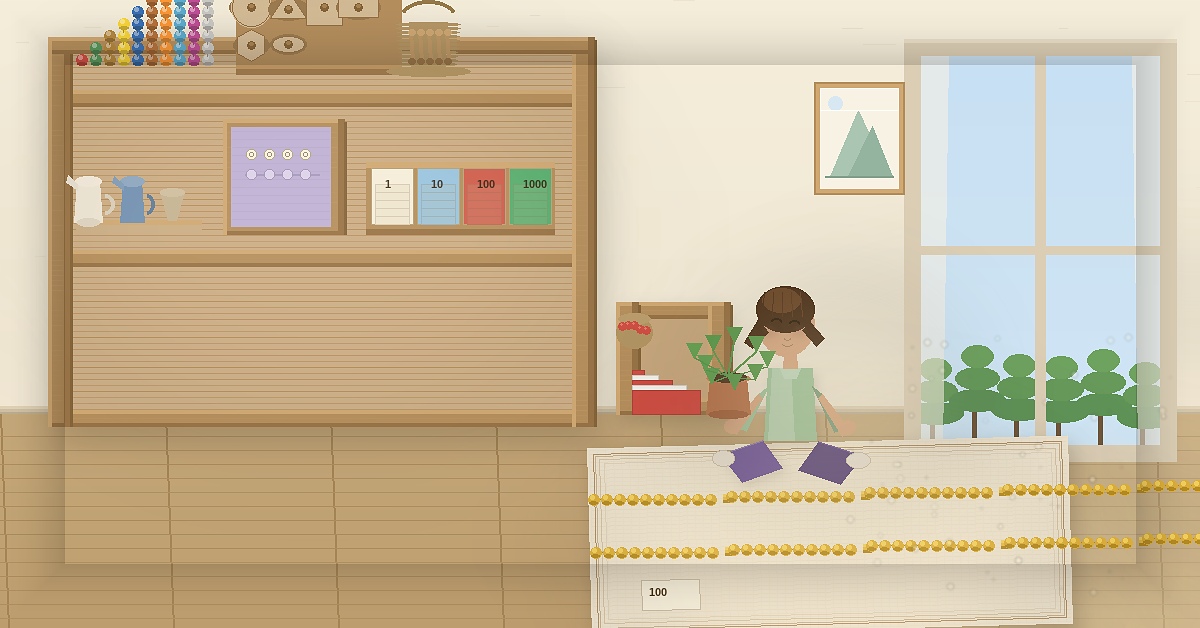
Classic Montessori materials include the Pink Tower (sensorial, size discrimination), the Sandpaper Letters (language, kinesthetic preparation for writing), the Golden Beads (mathematics, place value made physical), the Moveable Alphabet (language, word building), Botany Cabinet (science, leaf classification), and hundreds more. A complete primary Montessori material set from a quality supplier costs $1,000–$3,000+.
However: the cost is not the method. Many Montessori materials can be made at home from common materials. Montessori Manuals (montessorimanuals.org) provides complete, free curriculum manuals for every area — and describes the materials in enough detail for families to DIY or purchase strategically. The philosophy and the 3-hour work cycle are free; the materials can be acquired over time.
The Three-Hour Work Cycle
The most distinctive and counterintuitive element of Montessori homeschooling education is the 3-hour uninterrupted work cycle. This is not 3 hours of continuous concentrated work — it is 3 hours of uninterrupted access to the prepared environment, during which the child chooses their own work, works for as long as they choose on each material, and transitions between materials without adult interruption.
Research on the 3-hour work cycle by Angeline Lillard and others has found that children consistently demonstrate the deepest learning, highest engagement, and most complex cognitive activity in the final hour of the cycle — after the initial orientation period has passed and the child has settled into genuine concentration. Interrupting the work cycle prematurely (bells, scheduled lessons, adult interventions) cuts off the most valuable learning period.
For Montessori homeschooling families, implementing the 3-hour work cycle means protecting a block of morning time during which the child works independently with their Montessori materials. The parent is present as an observer and available for the ‘three-period lesson’ when introducing a new material — but not directing, questioning, or interrupting unless the child requests help.
What a Montessori Homeschooling Day Looks Like
7:00–8:00am
Morning Practical Life Routine
Child participates in real household tasks: setting the table, washing dishes, preparing a simple breakfast, watering plants. These are not chores assigned for behavior management — they are the Practical Life curriculum, developing coordination, concentration, and a sense of competence and contribution.
8:00–11:00am
The Three-Hour Work Cycle
Child works independently in the prepared environment. Parent observes, makes notes of what was chosen, and intervenes only if the child requests a new material or a lesson. The parent uses this time to prepare new presentations, maintain the environment, and track what the child needs next.
11:00–11:30am
Outdoor Time
Movement and nature. Essential — Montessori recognized the outdoor environment as an extension of the prepared environment. Gardening, nature observation, physical play.
11:30am–1:00pm
Lunch + Practical Life
Child helps prepare lunch (cutting soft foods, pouring, setting table). Lunch together. Child participates in cleanup.
1:00–2:00pm
Cultural Work or Story Time
Science, geography, history — often through living books read aloud, nature specimens, maps, or globe work. For younger children: nap or quiet rest.
2:00–3:30pm
Arts, Movement, or Free Exploration
Music, art, outdoor time, or additional independent work if the child chooses. The afternoon is less structured than the morning.
What a Montessori Homeschooling Week Looks Like
|
Day |
Morning |
Afternoon |
Notes |
|
Monday |
3-hour work cycle; parent introduces 1 new material |
Cultural: geography globe work; outdoor nature observation |
New material introduction day |
|
Tuesday |
3-hour work cycle; review previous week’s materials |
Art: process art with natural materials; music listening |
Consolidation day |
|
Wednesday |
3-hour work cycle; parent observes and records |
Practical Life extension: cooking project |
Deep observation day |
|
Thursday |
3-hour work cycle; mixed-age activity if co-op |
Community: park day, nature group, co-op visit |
Social connection day |
|
Friday |
3-hour work cycle; child-chosen extension activity |
Science experiment or cultural project; outdoor time |
Exploration + free learning |
Parent Reading Resources
The Absorbent Mind — Maria Montessori
Montessori’s own explanation of her discoveries, written for a general audience. More accessible than her earlier technical works. Essential reading for understanding why the method is designed the way it is — not as ideology but as observed reality.
The Montessori Toddler: A Parent’s Guide to Raising a Curious and Responsible Human Being — Simone Davies
The most practical and accessible Montessori home guide for families with children ages 1-3. Clear, beautiful, and honest about the realities of implementing Montessori at home. Required reading for families with toddlers.
The Montessori Child: A Parent’s Guide to Educating and Empowering Your Child — Simone Davies
Davies’ companion volume for ages 3-12. Covers setting up the home environment, working with different ages, and the most common Montessori home implementation challenges.
Montessori: The Science Behind the Genius — Angeline Stoll Lillard
The most rigorous academic review of the research on Montessori education. Lillard, a developmental psychologist, examines what the science says about each major element of Montessori practice. Essential for parents who need evidence, not just philosophy.
How to Raise an Amazing Child the Montessori Way — Tim Seldin
The most visually rich introduction to Montessori for home use. Strong on setting up the environment, choosing and presenting materials, and understanding the principles behind the practice. Beautiful photography makes it accessible for parents who learn visually.
Curriculum Picks: Secular, Neutral, Faith-Based, Budget & Screen-Free
free
Montessori Manuals (montessorimanuals.org)
✅ Covers all 5 SC required subjects | 💰 FREE (completely)
The single most important free Montessori homeschooling resource on the internet. Complete, authentic Montessori curriculum manuals across all subject areas — Practical Life, Sensorial, Mathematics, Language, Science, Social Studies — entirely free. Real Montessori instructional manuals, not activities or printables. A complete Montessori homeschooling program at zero curriculum cost. You still need materials, but the pedagogical guidance is here, free.
🔗 Visit montessorimanuals.org
🟢 SECULAR PICK
Keys of the World (KSYW)
✅ Covers all 5 SC required subjects | 💰 $200–$600+/year
The most comprehensive secular Montessori homeschooling curriculum guide. Covers Primary (ages 3-6) and Elementary (6-12) comprehensively, including mathematics, language, science, and social studies. Bridges authentic Montessori materials with a structured sequence parents can follow at home. One of the few resources that helps home educators implement the full Montessori homeschooling curriculum without formal Montessori training.
🔗 Visit keysoftheworld.net
🟢 SECULAR PICK
Cultivating Dharma
⚠️ Supplement needed for all subjects | 💰 $10–$30/month subscription
Secular online Montessori homeschooling education guides and planning resources for homeschool parents. Strong in 3-6 primary content. A good complement to physical Montessori materials for families who want ongoing curriculum support.
🔗 Visit cultivatingdharma.com
🟤 Faith-Based
Catechesis of the Good Shepherd
⚠️ Supplement needed for all subjects | 💰 $200–$600+/year (atrium materials)
Montessori-inspired religious formation program developed by Sofia Cavalletti. Used by Catholic Montessori homeschooling families as the faith component of a Montessori-influenced home education. Not a full academic curriculum — pairs with secular Montessori materials for academics.
🔗 Visit cgsusa.org
🟤 Faith-Based
The Good and the Beautiful + Montessori Materials
✅ Covers all 5 SC required subjects | 💰 Free (PDF) to $200/year
Many faith-based Montessori homeschooling families use TGATB as their language arts and history spine — activity-based, gentle pacing, self-directed options — while using Montessori math materials and nature-based science. Covers all five required subjects across the full program. A practical hybrid that serves families who want both Montessori homeschooling methods and faith-integrated content.
🔗 Visit goodandbeautiful.com
💸 Zero-Cost Options Within This Method
Montessori homeschooling at zero cost is genuinely achievable:
• Montessori Manuals (montessorimanuals.org) — complete free Montessori homeschooling curriculum manuals for every area
• DIY materials — many classic Montessori materials can be made at home:
– Sandpaper letters: sandpaper + cardboard + paint
– Color tablets: paint chips from the hardware store, sorted and matched
– Practical Life materials: real kitchen tools, cleaning supplies, pouring activities
– Sensorial: collections of natural objects sorted by size, texture, weight
• Khan Academy — free math from age 5+ for self-directed learners
• Your library — Montessori living books, picture books for cultural curriculum
• Nature — the best Montessori science environment is the outdoors; it costs nothing
• Thrift stores — many Montessori materials can be found secondhand (puzzles, stacking toys, nesting cups)
• Montessori homeschool Facebook groups — active buy/sell/swap communities for materials
A fully functional Montessori homeschooling primary environment can be built for under $200 DIY + thrift. The curriculum manuals are free.
📵 Screen-Free Within This Method
Montessori homeschooling is the most naturally screen-free method in this entire series:
• Montessori materials are physical, hands-on, and tangible by design — screens are antithetical
• The 3-hour work cycle depends on sustained physical engagement with real materials
• Practical Life work is entirely hands-on — pouring, cleaning, cooking, gardening
• Sensorial work is hands-on by definition — the child must touch, handle, and compare
• Nature study and outdoor work are screen-free
• Music in Montessori is live instruments and active listening, not passive screen consumption
Maria Montessori did not design her method for screens — and the core Montessori philosophy is more compatible with screen-free learning than any other educational approach.
If you want a completely screen-free education, Montessori provides one of the richest alternatives available.
Who Thrives in Montessori
✅ Montessori Homeschooling Often Works Well For:
• Independent, self-motivated children who prefer to work with their hands
• Children who are easily overstimulated by busy, noisy learning environments
• Kinesthetic learners who need to touch and manipulate materials
• Young children especially (ages 2-9) — Montessori is most powerful in these years
• Children who find traditional worksheets deadening or frustrating
• Families who want a calm, orderly, purposeful home learning environment
⚠️ Montessori Homeschooling May Challenge Families Who:
• Need a fully packaged daily lesson plan — Montessori requires parent observation and presentation skills
• Have children who need a lot of verbal engagement and interaction to stay motivated
• Have limited space or budget for materials — though DIY and free resources minimize this
• Are unschooling older teens (10+) where the Montessori material set becomes thinner
• Expect quick visible academic results — Montessori benefits compound slowly
Getting Started in Montessori Homeschooling
- Read The Montessori Toddler (for ages 1-3) or How to Raise an Amazing Child (for ages 3-6). Understand the philosophy before touching materials.
- Visit montessorimanuals.org and download the free manuals for your child’s age range. Study the sequencing of materials before purchasing anything.
- Set up one low shelf. Start with Practical Life materials only — a pouring activity, a simple sorting activity, a cleaning station. These cost almost nothing and teach the work cycle habits.
- Implement the 3-hour work cycle with what you have. The cycle is more important than the materials.
- Observe your child for two weeks before adding more. What are they drawn to? What do they ignore? Your child is telling you what to present next.
- Add materials gradually — one or two per week. A flood of new materials overwhelms even Montessori children.
- Join a Montessori homeschooling community online or locally for materials swap, presentation ideas, and peer support.
Frequently Asked Questions
Do I need Montessori training to teach Montessori homeschooling?
No — but you need to do significant reading. Montessori training helps you understand the philosophy deeply and use the materials effectively. Without it, the manuals from montessorimanuals.org, Davies’ books, and the Montessori homeschooling community provide sufficient guidance for most families. Be patient with yourself; Montessori home implementation is a learning curve.
Are expensive Montessori homeschooling materials necessary?
No. The philosophy and the 3-hour work cycle are free. Many materials can be DIYed. The most important investment is understanding the method well enough to present materials correctly and design the environment thoughtfully. Start with free resources and DIY materials; add quality purchased materials as you know what your child genuinely uses.
Does Montessori homeschooling work for older children (10+)?
Yes, but differently. The Montessori elementary and adolescent frameworks are less widely implemented than the primary program. Many Montessori homeschooling families transition toward a more eclectic approach as children grow, using Montessori principles (observation, independence, self-directed work) while adding subject-specific curricula for areas where Montessori materials are thinner (high school science, advanced mathematics).
How do I keep my toddler from disrupting my older child’s work cycle?
The traditional Montessori solution is the mixed-age environment — toddlers have their own shelf of age-appropriate materials nearby. The younger child is part of the work cycle, not a disruption to it. A dedicated toddler shelf with simple Practical Life and sensorial activities (sorting, stacking, pouring) keeps very young children engaged while older siblings work independently.
📚 CURRICULUM REVIEWS
In-depth reviews of secular and faith-based curricula at every price point.
🎁 FREE DOWNLOAD: New Homeschooler’s Starter Kit
Includes a method comparison worksheet, a ‘what does my child need?’ checklist, and a curated list of free Upstate SC resources — all in one free 8-page PDF.
📬 FIELD NOTES — Our Weekly Newsletter
Curriculum deals, new resource alerts, and real homeschool talk every Thursday at 9am. Free, always.
Sign-up here!
RELATED POSTS

👩💻 AUTHOR BIO
Crystal | Founder, The Homeschool Habitat
Crystal is a homeschooling mom in Upstate South Carolina and founder of The Homeschool Habitat.
She built this site because she remembers exactly how confusing those first Google searches felt — and wanted to create the clear resource she wished she’d had.
Follow @TheHomeschoolHabitat on Pinterest and Facebook.