Charlotte Mason Homeschooling: The Complete Easy Guide (6 Core Methods, Books, Daily Schedule)
Charlotte Mason was a 19th-century British educator who looked at the children of her time — stuffed with facts, drilled with textbooks, tested and graded and ranked — and saw something profound being lost: their humanity.
Her response was a complete philosophy of education she called ‘the science of relations.’ Children are not empty vessels to be filled with information, Mason argued. They are born persons — full human beings with minds, wills, and hearts — who deserve an education rich enough to nourish all three. An education built on beautiful books, direct experience with nature, attentive habits of mind, and the freedom to encounter ideas without the interference of a textbook author telling them what to think.
Nearly 150 years after Mason developed her method, families around the world are rediscovering what she understood: that children learn best when education feels like a rich life rather than a preparation for one. This guide is the most comprehensive available for families considering or beginning Charlotte Mason homeschooling — the philosophy, the methods, real schedules, curriculum choices across secular and faith-based options, and the parent reading that will make everything click.
Who Was Charlotte Mason and What Did She Believe?
Charlotte Mason (1842–1923) was a British educator who spent her life working with children, training teachers, and thinking carefully about what education should do. She founded the Parents’ National Educational Union (PNEU) and developed her method through decades of practice in real classrooms and homes. Her six-volume series, ‘The Original Home Schooling Series,’ remains in print and continues to be the primary source for families who want to understand CM from the source rather than from secondhand summaries.
Mason believed that the contemporary education of her time — and we could say the same of ours — made two fundamental errors. First, it treated children as objects to be shaped rather than persons to be respected. Second, it confused the communication of knowledge with education itself. A child who has memorized a list of historical dates has not been educated — they have been filled. A child who has read a living account of a historical moment, formed their own picture of it, narrated it back in their own words, and connected it to what they already know — that child has begun to be educated.
Mason’s method was developed with three foundational convictions: that children are born persons, that education is an atmosphere and a discipline and a life, and that the mind feeds on ideas rather than facts. Everything in Charlotte Mason homeschooling flows from these three convictions.
The Six Core Charlotte Mason Methods
Charlotte Mason homeschooling education is not a single technique but a constellation of interconnected practices. Understanding each one — and why it exists — is essential before trying to implement them.
1. Living Books
The cornerstone of Charlotte Mason homeschooling education. A living book is a book written by a single author who is passionate about their subject — not a committee-produced textbook summarizing information for passive consumption, but a real writer bringing a subject to life. Living books are narratives, not reference materials. A child who reads a living account of the American Revolution absorbs it differently than a child who reads a textbook paragraph about it — the living account enters the imagination and stays there.
2. Narration
Charlotte Mason’s primary assessment tool, and one of the most powerful learning techniques ever devised. After a reading (or nature walk, or museum visit, or lesson), the child is asked to tell back what they encountered — in their own words, without prompting, as completely as they can. This is not a quiz. It is the child’s mind actively processing and organizing what it has received. Narration can be oral (for younger children), written (for older), drawn (mapping the story), or enacted (acting out the scene). A child who narrates regularly develops comprehension, memory, organization, and expression simultaneously — all without a single worksheet.
3. Nature Study
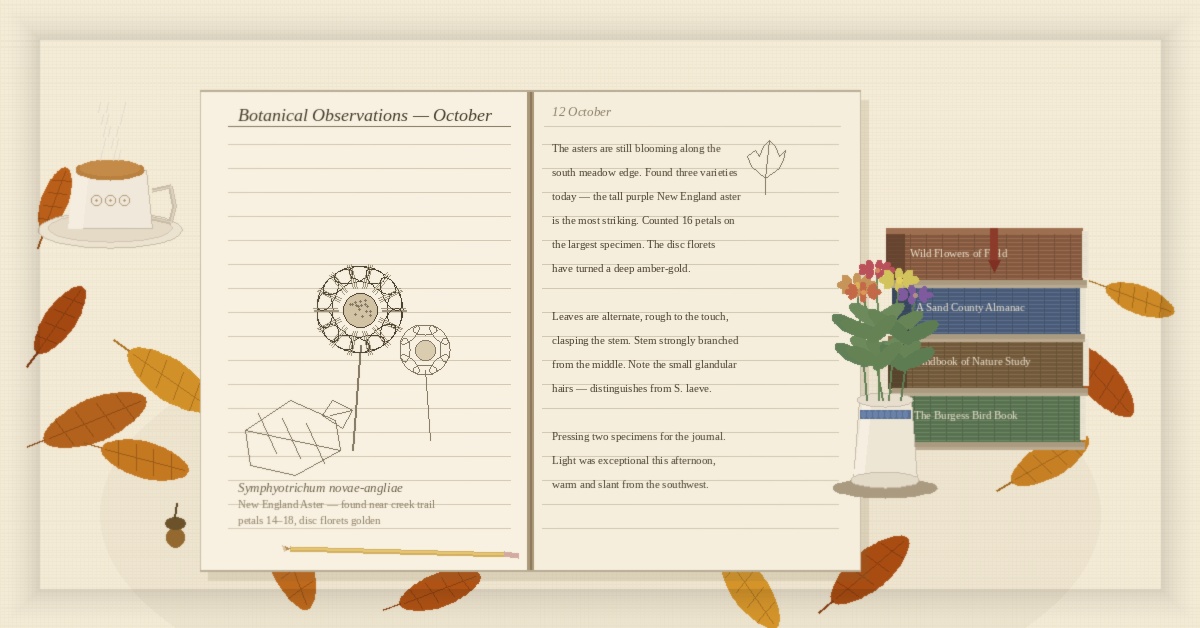
Charlotte Mason insisted on regular, attentive time in nature as a non-negotiable element of a full education. Not nature walks for the sake of exercise, but nature walks for the sake of observation — carrying a nature journal, sketching specimens, noting seasonal changes, learning the names and habits of local birds, plants, insects, and weather patterns. Nature study develops the habit of observation (paying careful, sustained attention to what is in front of you) which Mason considered one of the most important mental disciplines a person could possess.
4. Short Lessons
Charlotte Mason was decades ahead of the research on attention and learning when she insisted on short, focused lessons — 15–20 minutes for younger children, 30–45 minutes for older — separated by movement, outdoor time, or a change of subject. The insight is simple and still underappreciated: a child’s mind can concentrate intensely for short periods. Lessons that run past the natural window of attention produce diminishing returns at best and aversion to the subject at worst. Stop on time. Stop while the child still wants more.
5. Copywork and Dictation
Mason’s approach to handwriting, spelling, and grammar was not drill-based but immersive. Young children copy passages of beautiful prose or poetry — building handwriting, spelling, and exposure to excellent writing simultaneously. Older children move to dictation, where the parent reads a passage the child has studied and the child writes it from memory, having internalized both the content and the conventions. No separate grammar workbooks; no separate spelling lists. The grammar lives in the copywork.
6. Handicrafts and Living Arts
Charlotte Mason included regular practice of a handicraft — knitting, weaving, carpentry, needlework, drawing, watercolor — not as a frill but as essential education. Handicrafts develop patience, manual dexterity, aesthetic judgment, and the satisfaction of completing a real, useful object. They also provide a productive outlet during the periods between formal lessons and give children a relationship with the material world — how things are made, how they work — that no textbook can provide.
The Three Instruments of Education
🌳 Mason’s Core Framework
Charlotte Mason summarized her entire educational philosophy in three phrases: Education is an atmosphere, a discipline, and a life. These three phrases are the lens through which every CM practice makes sense.
An Atmosphere
The home environment itself educates — what children see, hear, handle, and absorb without being explicitly taught. The books on the shelves, the music playing in the background, the conversations at the dinner table, the art on the walls, the regularity of outdoor time — all of these constitute an educational atmosphere that teaches constantly without anyone standing at the front of a room. CM parents are curators of an environment as much as they are teachers of lessons.
A Discipline
Charlotte Mason meant by ‘discipline’ the formation of habit — not punitive correction, but the deliberate cultivation of good habits of mind and body: attention, observation, truthfulness, gentleness, promptness, self-control. Mason believed that good habits, once formed through consistent repetition, do much of the work of character formation without constant conscious effort. The daily rhythm of Charlotte Mason homeschooling education — same time for lessons, same time for outdoor time, same closing routine — is itself a discipline in this sense.
A Life
Education is not preparation for life — it is life itself. The things children study in a Charlotte Mason homeschooling education are not academic exercises but living realities: real plants, real birds, real historical people, real mathematical relationships, real stories. The child who spends an hour sketching a winter tree is not doing a science assignment — they are living as an attentive participant in the world. This distinction — between education-as-preparation and education-as-living — is perhaps the most radical and important thing Charlotte Mason understood.
What a Charlotte Mason Homeschooling Day Looks Like
A Charlotte Mason homeschooling day is gentle but full — unhurried in its pacing but rich in its content. The day is organized around a ‘morning time’ of shared readings, individual lessons in short focused blocks, outdoor time, and afternoon for handicrafts, art, and free learning. Here is a realistic day for a 9-year-old:
7:30–8:15am
Wake + Breakfast
Slow morning. No agenda. Conversation, quiet play, perhaps a window of outdoor observation before formal learning begins.
8:15–9:00am
Morning Time (Shared)
The family gathers. Scripture or poetry memorization, a hymn or folk song, a passage of classical music listened to attentively, a Shakespeare reading (once a term), map drill or geography review. Morning Time is not about completing tasks — it is about beginning the day together in a posture of attention and beauty.
9:00–9:20am
Mathematics
20 minutes of focused, sequential math instruction. Mason believed in math — she simply insisted it be done well, briefly, and with full attention. No math drill beyond the window of genuine concentration.
9:20–9:40am
Language Arts — Copywork or Dictation
15-20 minutes. Younger children copy a passage; older children prepare and then write a dictation passage from memory. No separate spelling or grammar workbook — this IS the grammar and spelling program.
9:40–9:50am
Movement Break
Outside if possible. 10 minutes, non-negotiable.
9:50–10:15am
Living History Reading + Narration
A parent reads aloud from the history spine (or child reads independently if fluent). Then the child narrates — verbally, in full, in their own words. No comprehension questions. The narration IS the comprehension check.
10:15–10:35am
Living Science or Nature Reading
A chapter from a nature book, a science narrative, or a biography of a scientist. Narration follows if time allows.
10:35–11:15am
Outdoor Nature Study
Outside with nature journal and pencil. Seasonal observation. Sketching one thing carefully. Naming one new thing. This is not free play — it is purposeful observation with a journal. Free play follows.
11:15am–12:00pm
Independent Reading or Free Time
Child reads independently (any book of interest) or has free, unstructured outdoor time.
12:00–1:00pm
Lunch + Read-Aloud
A chapter book read aloud — quality literature, not necessarily connected to the history spine. This is pleasure reading together.
1:00–2:30pm
Handicraft + Art Study
Knitting, watercolors, a nature sketch, picture study (examining one painting carefully for a term), composer study (listening to one composer’s work for a term). These are not rush activities — they develop slowly over the term.
🕐 Total Formal Lesson Time
Approximately 2.5–3 hours of focused instruction for ages 8–10. Younger children: 1.5–2 hours. Older children: 3–4 hours. Charlotte Mason homeschooling education is intentionally shorter than most school models because the quality of attention during lessons is protected by keeping them brief.
What a Charlotte Mason Homeschooling Week Looks Like
|
Day |
Morning |
Afternoon |
Notes |
|
Monday |
Morning Time, Math, Copywork, History reading + narration |
Nature study, picture study, free reading |
Standard full day |
|
Tuesday |
Morning Time, Math, Copywork, Science narrative + narration |
Art (watercolor or nature sketch), handicraft |
Arts-heavier afternoon |
|
Wednesday |
Morning Time, Math, Dictation, History project or timeline |
Nature study, free time, composer study |
Nature study emphasis |
|
Thursday |
Morning Time, Math, Copywork, Geography or biography |
Co-op or nature group, handicraft |
Community or enrichment day |
|
Friday |
Morning Time, review, Shakespeare or poetry reading |
Free learning, field trip, or extended nature time |
Lighter / enrichment day |
Parent Reading Resources
Charlotte Mason homeschooling education rewards parents who invest in understanding the philosophy. These are the essential reads:
Towards a Philosophy of Education (Volume 6) — Charlotte Mason
If you read only one volume of Mason’s original series, make it this one — her mature synthesis of everything she believed about education. More accessible than her earlier volumes. Available free at amblesideonline.org in the AO Library.
For the Children’s Sake: Foundations of Education for Home and School — Susan Schaeffer Macaulay
The book that introduced Charlotte Mason to modern homeschoolers. Warm, readable, and deeply convincing. This is most families’ entry point into CM and remains one of the best books ever written about what education is for. Read this before any curriculum purchase.
A Mind Alive: Charlotte Mason and the Science of Learning — Karen Glass
The most rigorous modern examination of CM’s educational philosophy and its alignment with contemporary cognitive science. Glass demonstrates that Mason’s intuitions about attention, memory, and learning were essentially correct — decades before the research caught up. Essential reading for analytical parents who want the ‘why’ behind CM methods.
Consider This: Charlotte Mason and the Classical Tradition — Karen Glass
Glass’s companion volume examining the relationship between CM education and classical education. Argues persuasively that Charlotte Mason was herself working within the classical tradition. Particularly valuable for families coming to CM from a classical background or considering combining elements of both.
A Charlotte Mason Companion: Personal Reflections on The Gentle Art of Learning — Karen Andreola
A warm, practical companion for families living the CM life. Less philosophical than Glass’s work, more anecdotal and personal. Excellent for the day-to-day questions about implementation — how to do narration, how to choose living books, how to organize morning time. The most-used reference book in many CM homes.
The Read-Aloud Revival: A Guide for Inspiring Your Child to Love Books and Learning — Sarah Mackenzie
Not a CM book specifically, but aligns perfectly with CM’s emphasis on read-alouds and living books. Mackenzie makes an evidence-based case for why reading aloud to children of all ages is the highest-return educational practice available. Required reading for every CM family.
Passionate Learners: How to Engage and Empower Your Students — Pernille Ripp
For CM families with children who struggle with formal learning. Ripp’s classroom-based insights about what actually engages children translate beautifully to the CM home — particularly the chapters on student voice and the damage of over-assessment.
Curriculum Picks: Secular, Neutral, Faith-Based, Budget & Screen-Free
🟢 SECULAR PICK
Moving Beyond the Page
⚠️ Supplement needed for all subjects | 💰 $150–$600/year (unit bundles by age)
The finest secular curriculum for Charlotte Mason homeschooling families. MBTP’s unit studies integrate language arts, social studies, and science through literature — exactly the living-books integration Mason prescribed. Exceptional writing instruction woven throughout. Designed for gifted and advanced learners who want depth. Math sold separately. The most content-rich secular CM option available.
🔗 Visit movingbeyondthepage.com
🟢 SECULAR PICK
Wildwood Curriculum
⚠️ Supplement needed for all subjects | 💰 $120–$400/year
A secular Charlotte Mason homeschooling curriculum designed specifically for families who want full CM fidelity without any faith content. Living books, narration, nature journals, copywork, handicrafts — all present. Carefully curated book lists of secular and religiously neutral titles. One of the cleanest secular CM options available.
🔗 Visit wildwoodcurriculum.com
🟢 SECULAR PICK
A Mind in the Light
⚠️ Supplement needed for all subjects | 💰 $100–$250/year
Secular Charlotte Mason homeschooling guides for the early years (K-4), with carefully selected living books and a gentle, organized approach. A good entry point for secular families new to CM who want a structured but relaxed starting place.
🔗 Visit amindinthelightblog.com
🟢 SECULAR PICK
Blossom and Root
⚠️ Supplement needed for all subjects | 💰 $20–$60/season
Secular seasonal nature-based learning guides for the early years (PreK–2nd grade). Beautifully designed, literature-rich, and deeply nature-integrated. Not a complete curriculum — pairs with library books and free resources — but one of the most beloved secular Charlotte Mason homeschooling options for young children.
🔗 Visit blossomandroot.com
🟤 Faith-Based
Simply Charlotte Mason
⚠️ Supplement needed for all subjects | 💰 $30–$300/year (modular)
The gold standard of faith-integrated Charlotte Mason homeschooling curriculum. Beautifully designed, deeply CM in philosophy, and gently faith-integrated — present but not heavy-handed. Covers all required subjects except math (recommended separately). Exceptional parent resources, YouTube channel, and free sample lessons. The most popular CM publisher for faith-based families and for good reason.
🔗 Visit simplycharlottemason.com
🟤 Faith-Based
A Gentle Feast
⚠️ Supplement needed for all subjects | 💰 $15–$40/term
A newer Charlotte Mason homeschooling curriculum with beautiful design and strong faith integration. Organized by terms (Mason’s preference) rather than semesters. Strong in morning time organization and picture/composer study. Growing community and resource library.
🔗 Visit agentlefeast.com
🟤 Faith-Based
Beautiful Feet Books
⚠️ Supplement needed for all subjects | 💰 $45–$130/guide
History and literature through primary and living books — one of the most beloved Charlotte Mason homeschooling approaches to history. Geography of the World, History Through Literature, and other subject-specific guides. Faith-integrated, living-books approach that pairs beautifully with Ambleside Online or Simply Charlotte Mason.
🔗 Visit bfbooks.com
Free Pick
Ambleside Online
✅ Covers all 5 SC required subjects | 💰 Free (completely)
A completely free, comprehensive Charlotte Mason homeschooling curriculum K-12 built by a community of CM educators. Year-by-year reading lists, schedules, and guides based on Mason’s original booklists with some updates. Uses library books as the curriculum — the guides direct the reading. Some Christian content in older books. Used by both secular (with substitutions) and faith-based families. One of the great gifts of the Charlotte Mason homeschooling world.
🔗 Visit amblesideonline.org
💸 Zero-Cost Options Within This Method
Charlotte Mason homeschooling is one of the most budget-friendly methods because the curriculum IS the library:
• Ambleside Online — complete K-12 CM curriculum at zero cost; amblesideonline.org
• Your library — all Ambleside books borrowed free; most also available as audiobooks on Libby
• Librivox — free audiobooks of classic and CM-compatible literature
• Nature journal — a blank composition notebook and pencil; total cost $2
• Copywork — any beautiful passage from any book; no curriculum needed
• Narration — completely free; requires only the parent’s ears
• Picture study — public domain artwork from artists.org, nga.gov, and WikiArt; all free
• Composer study — Spotify, YouTube Music, or your library’s CD collection; free or near-free
• Folk songs and hymns — YouTube, Spotify, or family singing; free
A complete Charlotte Mason education from K-12 can be run for $0 with a library card. Ambleside Online is the free spine; everything else it recommends is borrowable.
📵 Screen-Free Within This Method
Charlotte Mason homeschooling education is one of the most naturally screen-free methods:
• Living books are physical books — read aloud from a real page
• Narration is spoken — child to parent, no device involved
• Nature journals are paper and pencil — not digital
• Copywork uses handwriting — pen or pencil on paper
• Picture study examines physical prints (or library art books) — not screens
• Morning Time — poetry, music, reading — is inherently non-digital
• Handicrafts are entirely hands-on and screen-free by definition
• Nature study is the screen-free activity par excellence
The only areas where CM families sometimes use screens: audiobooks (Libby app for library access), composer study (streaming music), and art prints (viewing on a tablet). All three are optional — physical alternatives exist for every one.
If you want a completely screen-free CM education, the only things you need are books, a nature journal, and time outdoors. The method asks nothing else.
Who Thrives in Charlotte Mason
✅ Charlotte Mason Homeschooling Often Works Well For:
• Children who love stories, nature, and imaginative play
• Families who want a gentle but intellectually rich environment
• Parents drawn to a slower pace of learning that honors childhood
• Children who learn through narrative and relationship rather than drill
• Families who want education to feel like a beautiful life, not a replication of school
• Young children (K-4) especially — CM is unusually strong in the early years
• Children with attention challenges who need short, varied lessons
⚠️ Charlotte Mason Homeschooling May Challenge Families Who:
• Need explicit, sequential skill instruction in reading (phonics must be taught deliberately)
• Want a packaged, scripted daily lesson plan requiring no parent creativity
• Measure educational success primarily through test scores and academic benchmarks
• Have children who prefer structure and predictability over narrative and exploration
• Cannot access a good library system — CM is library-dependent
Getting Started: Your First Charlotte Mason Homeschooling Year
- Read For the Children’s Sake by Susan Schaeffer Macaulay. This is the Charlotte Mason homeschooling philosophy in its most accessible form.
- Visit amblesideonline.org. Browse Year 1 and Year 2. Understand the structure before choosing.
- Get a library card. CM runs on library books — this is not optional.
- Buy a blank composition notebook and a good pencil for your child’s nature journal.
- Choose your first morning time elements: one poem to memorize, one piece of music to listen to attentively, one hymn or folk song. Start there.
- Find a living book on a topic your child is already interested in. Read it aloud. Then ask: ‘Tell me what you remember.’ That narration is the whole method in miniature.
- Go outside. Every day if possible. Even for 15 minutes. Bring the journal.
- Choose a math program separately — CM does not have a strong native math tradition. Khan Academy (free) or Math-U-See pair well.
- Give yourself a term (12 weeks) before evaluating. Charlotte Mason homeschooling unfolds slowly. The benefits compound over time.
🌿 What CM Feels Like When It Works
When Charlotte Mason homeschooling education is working, it does not feel like school.
It feels like a childhood that is also an education.
Your child asks questions you didn’t plan for. Your nature journals fill with real observations.
The books you read aloud become part of your family’s shared language.
You find yourself lingering over a spider web or a winter tree because your child has taught you how to look.
That is the whole point. Education as a way of seeing the world.
Frequently Asked Questions
Do I need to follow Ambleside Online exactly?
No. Ambleside Online is a guide, not a mandate. Many families use AO as their spine and substitute individual books, adjust the pace for their child’s reading level, add or remove elements to match their values, or use it only for history while using another program for math and language arts. The AO community forums are an excellent resource for families adapting the curriculum.
My child won’t narrate. What do I do?
Start with very short readings — 5 minutes — and ask immediately after. Don’t use comprehension questions alongside narration; they undermine it. For very young children, accept a single sentence: ‘What is one thing you remember?’ Accept pictures as narration for children who struggle with words. For children who genuinely resist, narration can also be drawn (sketch the scene), acted out (pretend you’re the character), or mapped (draw where it happened). The format matters less than the habit of recalling.
How do I handle multiple children with different ages in Charlotte Mason?
Charlotte Mason works beautifully for multi-age families because morning time, history, science, and nature study can all be shared across ages — the depth of engagement scales naturally. A 6-year-old and a 10-year-old can hear the same history read-aloud; their narrations will be entirely different, reflecting their respective development. Math and language arts are done individually.
Is Charlotte Mason the same as unschooling?
No — though they share some DNA. Both honor children’s natural curiosity and resist over-formalization. But CM is a structured method with specific practices (narration, copywork, nature journals, morning time) and a sequenced book list. Unschooling is a philosophy that follows the child’s lead with no imposed curriculum. Charlotte Mason homeschooling is child-respecting but not child-directed.
📚 CURRICULUM REVIEWS
In-depth reviews of secular and faith-based curricula at every price point.
🎁 FREE DOWNLOAD: New Homeschooler’s Starter Kit
Includes a method comparison worksheet, a ‘what does my child need?’ checklist, and a curated list of free Upstate SC resources — all in one free 8-page PDF.
📬 FIELD NOTES — Our Weekly Newsletter
Curriculum deals, new resource alerts, and real homeschool talk every Thursday at 9am. Free, always.
Sign-up here!
RELATED POSTS

👩💻 AUTHOR BIO
Crystal | Founder, The Homeschool Habitat
Crystal is a homeschooling mom in Upstate South Carolina and founder of The Homeschool Habitat.
She built this site because she remembers exactly how confusing those first Google searches felt — and wanted to create the clear resource she wished she’d had.
Follow @TheHomeschoolHabitat on Pinterest and Facebook.