Top 15 Homeschool Curriculums for 2026: Best Secular, Faith-Based & Free Options by Method
📢 Affiliate Disclosure
This post contains affiliate links. If you purchase through our links, we may earn a commission at no extra cost to you.
We only recommend curricula we have genuinely reviewed. Commissions do not influence our picks or ratings.
Most homeschool curriculum roundup posts give you a list of programs. This one is organized differently — by learning method first, then worldview.
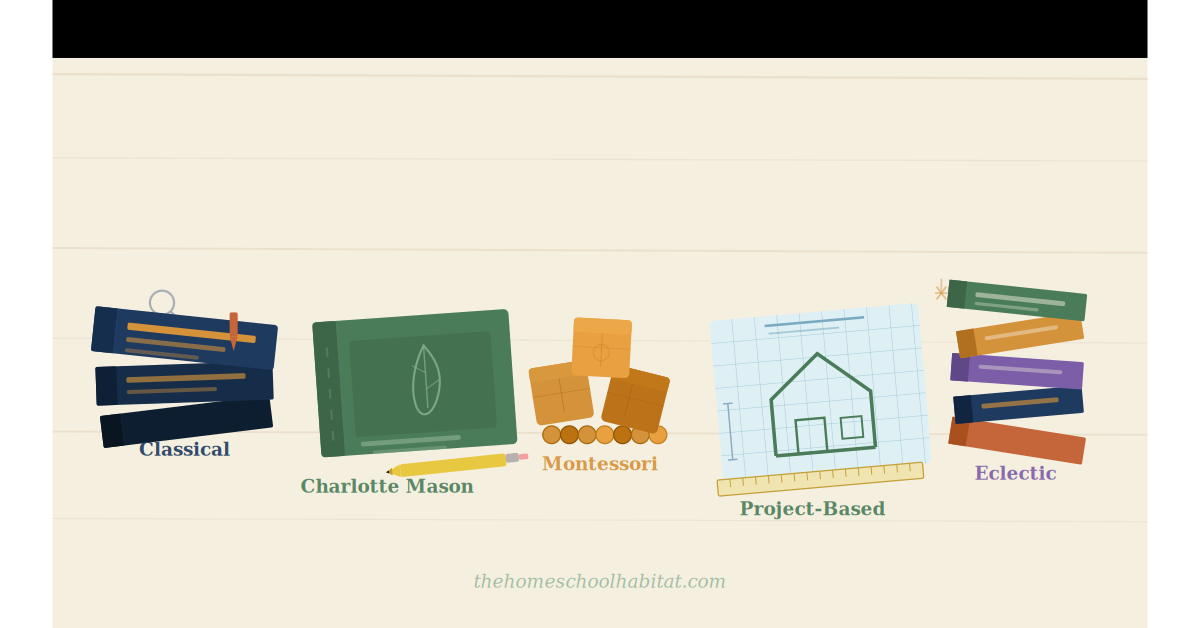
Why does method matter? Because the right homeschool curriculum for a Charlotte Mason family looks completely different from the right homeschool curriculum for a classical family — even if both families want faith-integrated content, or both want secular content. Method shapes everything: the pace, the approach, the daily feel, the parent’s role.
For each of the five major homeschool curriculum methods, we’ve chosen three curricula: the best secular option, the best faith-based option, and a genuinely good free alternative. That’s 15 total reviewed programs — plus a bonus section on unschooling for families who aren’t ready for formal curriculum yet.
Each review tells you whether the homeschool curriculum covers all five legally required subjects in South Carolina (reading, writing, math, science, and social studies). Many complete programs cover all five; some are designed as subject-specific supplements that need to be paired with additional resources.
📌 New to Homeschool Curriculum Methods?
If you’re not sure which method fits your family, start with our in-depth guide:
→ 6 Homeschool Methods Compared: Classical, Charlotte Mason, Unschooling, Montessori, Project-Based & Eclectic
Come back here once you know which method resonates; your homeschool curriculum choices will narrow down significantly.
Subject Coverage at a Glance
South Carolina law requires instruction in five core subjects: Reading, Writing, Mathematics, Science, and Social Studies (grades K-6). Grades 7-12 also require Composition and Literature. The table below shows which homeschool curriculums cover all five required subjects in a single program, and which require supplementation.
|
Curriculum |
Math |
Reading |
Writing |
Science |
Soc. Studies |
Note |
|
Memoria Press |
✅ |
✅ |
✅ |
✅ |
✅ |
Grades K-12 |
|
Classical Conversations |
✅ |
✅ |
✅ |
✅ |
✅ |
Grades K-12, community-based |
|
Classical Academic Press |
⚠️ |
✅ |
✅ |
⚠️ |
⚠️ |
Supplement math & science & Social Studies for K-5 |
|
Wildwood Curriculum |
⚠️ |
✅ |
✅ |
✅ |
✅ |
Math supplement needed |
|
Simply Charlotte Mason |
⚠️ |
✅ |
✅ |
✅ |
✅ |
Math supplement needed |
|
Ambleside Online (Free) |
⚠️ |
✅ |
✅ |
✅ |
✅ |
Math supplement needed; library dependent |
|
Keys of the World |
✅ |
✅ |
✅ |
✅ |
✅ |
Comprehensive Secular Montessori |
|
Montessori for Homeschoolers |
✅ |
✅ |
✅ |
✅ |
✅ |
Comprehensive faith-based Montessori |
|
Montessori Manuals (montessorimanuals.org) |
✅ |
✅ |
✅ |
✅ |
✅ |
Free complete manuals; material sourced separately |
|
Timberdoodle |
✅ |
✅ |
✅ |
✅ |
✅ |
Annual kits cover all subjects |
|
Apologia |
✅ |
⚠️ |
⚠️ |
✅ |
✅ |
Science-led; add reading, writing for K-6 |
|
Outschool (Free Classes) |
✅ |
✅ |
✅ |
✅ |
✅ |
Content guides; |
|
Time4Learning |
✅ |
✅ |
✅ |
✅ |
✅ |
All-in-one K-12 |
|
Good and the Beautiful |
✅ |
✅ |
✅ |
✅ |
✅ |
All-in-one K-12 |
|
Khan Academy (Free) |
✅ |
✅ |
✅ |
✅ |
✅ |
All-in-one K-12 |
📌 SC Subject Coverage Note
SC requires: Reading, Writing, Math, Science, Social Studies (K-6)
PLUS Composition and Literature for grades 7-12(note: composition and literature are just fancier words for writing and reading).
All-in-one programs (Time4Learning, Timberdoodle, Good & Beautiful, Khan Academy, Montessori for Homeschoolers, Memoria Press, Classical Conversations) are the easiest path to covering all subjects without building your own homeschool curriculum.
📜 Classical Education
Logic, language, and the Western tradition — the Trivium in action
Classical education follows the Trivium — Grammar (foundational knowledge), Logic (critical thinking), and Rhetoric (persuasive expression). It’s rigorous, language-rich, and historically rooted. The homeschool curriculum below represent the best classical options across secular, faith-based, and free categories.
🟢 SECULAR PICK
Memoria Press
Rigorous classical content with lighter faith integration than most
✅ Covers all 5 SC required subjects | 💰 $300–$1,500/year (buy by subject)
✅ Strengths: One of the most academically rigorous classical programs available. Strong in Latin, literature, logic, and the Great Books tradition. Faith integration is present but relatively light compared to CC or Veritas — many secular or mixed-faith families use it comfortably. Covers all five SC required subjects across the full program.
⚠️ Consider: Explicitly classical and traditional — not a fit for families who want discovery-based or child-led learning. Latin is woven in from early grades. Some subject areas (science especially) are more traditional than hands-on. Memoria Press is traditionally faith-based(as is most classical education) but recently has created an option for secular families.
Verdict: The best option for classically-minded secular families who want rigorous academics without heavy faith overlay. Excellent writing instruction. Works beautifully subject-by-subject.
🔗 Visit charter.memoriapressonline.com to request a secular built curriculum or memoriapress.com for faith-based
🟤 FAITH-BASED PICK
Classical Conversations
Classical Christian education with a built-in weekly co-op community
✅ Covers all 5 SC required subjects | 💰 $1,000–$1,800/year (community tuition + curriculum)
✅ Strengths: The most widely used classical program in the country — and for good reason. CC’s community model means your child attends a weekly co-op with other CC families for memory work, presentations, and Socratic discussion. Covers all five SC required subjects across the three stages (Foundations, Essentials, Challenge). Explicit Christian worldview throughout.
⚠️ Consider: Higher cost when community tuition and curriculum are combined. The heavy memorization in Foundations stage isn’t suited to every learning style. Requires weekly attendance commitment. Not suitable for secular families.
Verdict: Classical Conversations is both a curriculum and a community — and the community is the real product. If you want classical rigor AND a built-in weekly peer group, nothing else compares.
🔗 Visit classicalconversations.com
✨ BONUS FREE OPTION
Classical Academic Press (selected free resources)
+ Well-Trained Mind library approach
Build your own classical program using free and low-cost resources
⚠️ Partial coverage — supplement needed | 💰 $0–$100/year using library + free downloads
✅ Strengths: Classical Academic Press offers free sample lessons and some free resources online. Pair their free writing/logic resources with the Well-Trained Mind’s reading lists (using library books — free) and Khan Academy for math and you have a solid, classically-flavored program at near-zero cost. Susan Wise Bauer’s SOTW (Story of the World) Vol. 1-4 can be borrowed from most libraries.
⚠️ Consider: Requires significant parent planning and curation. Not a plug-and-play solution. Math instruction through Khan Academy alone may not be rigorous enough for older classical learners. Writing instruction requires deliberate supplementation.
Verdict: The best free entry point into classical education. Ideal for families who want to try classical before investing in a complete program. Plan to spend 2-3 hours setting this up initially — then it flows.
🔗 Visit classicalacademicpress.com
🌿 Charlotte Mason
Living books, narration, nature study, and the whole child
Charlotte Mason education centers on living books (beautifully written books by real authors), narration (the child retells what they’ve learned), nature study, and short, focused lessons. It’s gentle, literature-rich, and deeply attentive to childhood development. Math is almost always supplemented separately — no CM-specific math program is universally loved.
🟢 SECULAR PICK
Wildwood Curriculum
A fully secular, literature-rich Charlotte Mason program with no religious content
⚠️ Partial coverage — supplement needed | 💰 $120–$400/year
✅ Strengths: Wildwood is one of the only secular Charlotte Mason homeschool curriculum designed from the ground up without religious content — not adapted, not lightly edited. It covers language arts, history, science, and literature through living books, narration, nature study, and artist/composer study exactly as Charlotte Mason intended. Beautifully organized, clear guides for the parent, and genuinely faithful to CM philosophy. Math supplement required (Khan Academy or Math-U-See pair well).
⚠️ Consider: Math not included — you will need a dedicated math program. Requires library access for living books. Not a plug-and-play system — parent investment in understanding the CM approach helps significantly. Smaller community and fewer resources than Simply Charlotte Mason.
Verdict: The clearest secular Charlotte Mason option on the market. If you want genuine CM philosophy without any faith content whatsoever, Wildwood delivers it. Add Khan Academy for math and you’re complete.
🔗 Visit wildwoodcurriculum.com
🟤 FAITH-BASED PICK
Simply Charlotte Mason
The gold standard of faith-integrated Charlotte Mason curriculum — gentle, beautiful, complete
⚠️ Partial coverage — supplement needed | 💰 $30–$300/year (highly modular)
✅ Strengths: Simply Charlotte Mason is the most beloved Charlotte Mason publisher for faith-based families. Their homeschool curriculum guides cover all required subjects except math (which they address separately with CM-compatible options). Beautifully designed, deeply CM in philosophy, and gently faith-integrated rather than overtly evangelical. Narration, nature journals, living books, and handicrafts all woven together naturally.
⚠️ Consider: Math requires a separate program — SCM recommends Singapore or Math-U-See. The CM method has a learning curve for parents new to it. Requires library access for living books. Not a plug-and-play system — parent planning is involved.
Verdict: The right choice for faith-based families who want a genuine Charlotte Mason education. SCM has spent decades refining this approach — you benefit from that depth. Add a math program and you’re complete.
🔗 Visit simplycharlottemason.com
✨ BONUS FREE OPTION
Ambleside Online
The original free Charlotte Mason homeschool curriculum — complete K-12 using library books
⚠️ Partial coverage — supplement needed | 💰 $0 (completely free — curriculum is library books + free guides)
✅ Strengths: Ambleside Online is the closest thing homeschooling has to a free complete Charlotte Mason curriculum. AO publishes full year-by-year reading lists, schedules, and guides based on Charlotte Mason’s original booklists with some updates. It covers all subjects except math through living books, narration, and nature study. Widely used by both secular and faith-oriented families (some Christian content in original books).
⚠️ Consider: Requires heavy library access — the curriculum IS the books, and you need access to many of them. Some books are older and include content modern families may want to preview first. Math supplement required. Requires significant parent investment to implement well — AO is not a teacher’s manual. This homeschool curriculum is faith-based.
Verdict: The best free entry point into classical education. Ideal for families who want to try charlotte mason before investing in a complete program. Plan to spend 2-3 hours setting this up initially — then it flows.
🔗 Visit amblesideonline.org
🔢 Montessori
Prepared environments, hands-on materials, and child-led mastery
Montessori education centers on the prepared environment, hands-on self-correcting materials, and the child choosing their own work. It’s strongest in the early years (ages 2-9) and requires physical materials that involve some investment. The three picks below range from comprehensive homeschool curriculum guides to affordable subscription tools to free online resources.
🟢 SECULAR PICK
Keys of the World (KSYW)
The most comprehensive secular Montessori curriculum guide for home use
✅ Covers all 5 SC required subjects | 💰 $200–$600/year
✅ Strengths: Keys of the World bridges authentic Montessori materials with a structured sequence parents can follow at home without formal Montessori training. Covers primary (ages 3-6) and elementary (6-12) comprehensively, including math, language, science, and social studies. One of the few Montessori resources that explicitly helps home educators implement the full Montessori curriculum — not just activities.
⚠️ Consider: Materials cost is significant on top of the homeschool curriculum — a full Montessori primary shelf can run $500-2,000+. KSYW provides the guide; you source the materials. Requires parent study to implement well. Not a plug-and-play system.
Verdict: The best secular home Montessori option for families committed to the method. Pairs with physical Montessori materials from suppliers like Alison’s Montessori or Michael Olaf.
🔗 Visit keysoftheworld.net
🟤 FAITH-BASED PICK
Montessori for Homeschoolers
A complete faith-based Montessori curriculum designed specifically for home educators
✅ Covers all 5 SC required subjects | 💰 $200–$700/year
✅ Strengths: Montessori for Homeschoolers is one of the few programs built explicitly as a faith-integrated Montessori homeschool curriculum — not adapted from a school program, not a loose collection of activities, but a structured, sequential Montessori program with Christian faith woven naturally throughout. Covers all five SC required subjects across the full program. Includes guides for setting up your home environment, lesson presentations, and extensions — the practical support that Montessori home educators often struggle to find.
⚠️ Consider: Physical Montessori materials are still required on top of curriculum cost. Not as widely known as secular Montessori resources, so the community support base is smaller. Best results with a commitment to the full Montessori prepared environment, not just the worksheets.
Verdict: The most complete faith-based Montessori home curriculum available. For Christian families committed to the Montessori method, this closes the gap that most Montessori resources leave open on the faith side.
🔗 Visit montessoriforhomeschoolers.com
✨ BONUS FREE OPTION
Montessori Manuals — montessorimanuals.org
100% free, complete Montessori manuals for every area of the curriculum
✅ Covers all 5 SC required subjects | 💰 $0 (completely free — no subscription, no paywall)
✅ Strengths: Montessori Manuals offers complete, authentic Montessori curriculum manuals across all subject areas — practical life, sensorial, math, language, science, and social studies — entirely free. These are real Montessori instructional manuals, not activities or printables. This is one of the most underknown resources in the homeschool world. Covers all five SC required subjects through the Montessori framework. Pair with physical Montessori materials (purchased or DIY) and you have a complete, genuine Montessori home program at zero curriculum cost.
⚠️ Consider: The manuals are the instruction — you still need physical Montessori materials to implement them, which have their own cost (though many can be DIY’d or purchased used). Requires parent study to understand the Montessori sequence before teaching. Not a plug-and-play daily planner — you build the plan from the manuals.
Verdict: One of the best-kept secrets in homeschooling. Complete, authentic Montessori manuals at no cost whatsoever. If you want genuine Montessori at home and are willing to source or make your own materials, this resource removes the homeschool curriculum cost barrier entirely.
🔗 Visit montessorimanuals.org
🔧 Project-Based Learning
Real problems, real products — academic skills embedded in doing
Project-Based Learning (PBL) organizes academic content around extended, real-world projects. A child doesn’t study the American Revolution from a textbook — they research it, write from a colonist’s perspective, debate its causes, and build something that demonstrates their understanding. Academic skills (reading, writing, math, science) are embedded in the work of doing something real. PBL scales beautifully into middle and high school.
🟢 SECULAR PICK
Timberdoodle
Beautifully curated hands-on annual kits that do the project-planning for you
✅ Covers all 5 SC required subjects | 💰 $300–$900+/year (complete kit)
✅ Strengths: Timberdoodle’s annual homeschool curriculum kits combine engineering projects, logic puzzles, hands-on art, science experiments, and academic content into a curated all-in-one kit. They do the curation work so you don’t have to. Covers all five SC required subjects across the complete kit. Especially beloved for the K-6 age range. Secular-leaning with some faith-based kit options.
⚠️ Consider: The kit model means less flexibility to swap individual components. Heavier on enrichment than on explicit writing instruction — most families add a standalone writing program. Higher cost for a complete kit. Not a fit for teens who want more self-direction.
Verdict: The best secular PBL-adjacent option for families who want hands-on learning without spending 20 hours planning projects themselves. Open the kit, follow the guide, watch your child engage.
🔗 Visit timberdoodle.com
🟤 FAITH-BASED PICK
Apologia
Investigative, lab-heavy Christian science homeschool curriculum built on the scientific method
⚠️ Partial coverage — supplement needed | 💰 $85–$160/level (science only)
✅ Strengths: Apologia is the most widely used Christian science homeschool curriculum in the homeschool world — and it is genuinely project-based in its approach. Each course is built around the scientific method: students form hypotheses, conduct hands-on experiments, record observations, and draw conclusions. Labs are not optional extras; they are the spine of the program. Young Explorer series (K-6) covers botany, zoology, astronomy, anatomy, and earth science through investigation, notebooking, and real experiments. Explicit Christian worldview, written conversationally to the student. Covers science and social studies components; math, reading, and writing require separate programs.
⚠️ Consider: Science and social studies coverage only — you will need separate programs for math, reading, and writing. Explicit Young-Earth creationist perspective in some titles; review content for your family’s alignment before purchasing. Not a complete all-in-one program.
Verdict: The best faith-based project-based science homeschool curriculum available. If your family values hands-on investigation, real labs, and a Christian worldview in science, Apologia delivers better than anything else in its category. Pair with a strong language arts and math program to complete your year.
🔗 Visit apologia.com
✨ BONUS FREE OPTION
Outschool + YouTube + Khan Academy
Build a project-based program using the best free platforms and live classes
✅ Covers all 5 SC required subjects | 💰 $0 (free platforms) + $10–$50/class if using Outschool
✅ Strengths: A PBL approach can be built almost entirely free: Khan Academy for math (free), YouTube documentary and how-to channels for science and social studies (free), library books for research and reading (free), and your child’s own projects and interests as the spine. Outschool adds live instructor-led project classes (not free, but pay-per-class and affordable plus tons of free classes). This combination is flexible, child-driven, and zero-cost if you skip Outschool.
⚠️ Consider: Requires the most parent investment of any pick in this post — there is no packaged program here, just tools. Families who need a daily plan will struggle. Works beautifully for self-directed, curious learners; not ideal for children who need explicit structure.
Verdict: The best free PBL approach for families with a self-directed learner who hates being told what to do. Use your child’s obsessions as projects and fill in the gaps with Khan and library books.
🔗 Visit outschool.com
🎨 Eclectic / DIY Homeschooling
The best of everything — mix, match, and build what actually works
Eclectic homeschooling is exactly what it sounds like — pulling the best of multiple methods and curricula to fit your specific child. It’s how most experienced homeschool families operate, and it produces extraordinary results when done with intention. The three picks below represent three different approaches to building an eclectic program: a complete all-in-one, a faith-based all-in-one, and a curated free combination.
🟢 SECULAR PICK
Time4Learning
The most complete secular all-in-one program — open it and start
✅ Covers all 5 SC required subjects | 💰 $24.95–$34.95/month
✅ Strengths: Time4Learning covers all five SC required subjects in a single online platform for grades K-12. For eclectic families who want one organized, reliable spine to build from — then layer their own interests and projects on top — T4L is the clearest foundation. Interactive, self-paced within the platform, and easy for parents to manage. The most popular secular all-in-one in the homeschool world.
⚠️ Consider: Screen-heavy. Writing instruction is functional but not exceptional — many families add a writing program (Brave Writer pairs well). Not philosophically rich — it’s instruction, not inspiration. Some families outgrow it and need more depth in upper grades.
Verdict: The best secular foundation for an eclectic home. Use T4L for your core subjects, then layer your family’s interests, read-alouds, projects, and community on top. That combination is genuinely excellent.
🔗 Visit time4learning.com
🟤 FAITH-BASED PICK
The Good and the Beautiful
A complete, beautifully designed all-in-one faith-based curriculum at an exceptional price point
✅ Covers all 5 SC required subjects | 💰 Free (PDF) to $200/year
✅ Strengths: The Good and the Beautiful covers all five SC required subjects across its full program — math, language arts, science, and history — and does it at a price point that rivals free. The PDF versions of every level are downloadable at no cost. Production quality is exceptional: beautiful layouts, engaging content, and gentle faith integration that doesn’t feel heavy-handed. For eclectic families who want one complete, reliable faith-integrated spine they can then supplement with their own interests, TGATB is the clearest foundation in this category.
⚠️ Consider: Math program receives more mixed reviews than language arts — some families supplement with a dedicated math program (Math-U-See or Saxon pair well). Not suitable for secular families. Some upper-level content is still in development.
Verdict: The best value in faith-based homeschool curriculum — possibly in all of homeschool curriculum. For eclectic faith-based families who want a complete, beautiful, affordable foundation, nothing else matches the combination of quality and cost. Start with the free PDFs before purchasing print.
🔗 Visit goodandbeautiful.com
✨ BONUS FREE OPTION
Khan Academy + Core Knowledge + Brave Writer Lifestyle + Library
The best free all-subjects combination for eclectic homeschoolers
✅ Covers all 5 SC required subjects | 💰 $0 (completely free)
✅ Strengths: This combination covers all five SC required subjects at zero cost: Khan Academy for math (free, K-12, genuinely excellent), Core Knowledge Sequence PDFs from coreknowledge.org for science and social studies framework (free), Brave Writer’s free blog and resources for writing approach (free, with paid upgrades optional), and your library for all reading and literature. This is not a backup plan — this is a legitimate, complete, research-backed education at no cost.
⚠️ Consider: Requires the most parent coordination of any pick in this post. There is no single platform, no one daily plan. You are the curriculum director. Families who need external accountability will find this challenging. Writing instruction through Brave Writer’s free resources alone requires parent engagement and consistency.
Verdict: If budget is a barrier to homeschooling, this combination removes it entirely. Khan + Core Knowledge + library is a complete education. Do not let cost be the reason you don’t start.
🔗 Visit khanacademy.org, coreknowledge.org, bravewriter.com
✨ BONUS: What If You’re Not Ready for Curriculum Yet?
🌀 The Unschooling Option
If buying homeschool curriculum feels overwhelming, expensive, or premature — you might not need one yet.
Unschooling is a legitimate, legal, research-supported approach to education that uses life, curiosity, and real experience as the curriculum. It is not ‘doing nothing.’ It is doing everything — just without a textbook telling you to.
What Unschooling Looks Like in Practice
An unschooling family doesn’t follow a homeschool curriculum. They provide a rich environment — libraries, nature, tools, conversations, mentors, experiences — and follow their child’s lead. Learning happens through obsessions, real-world problems, play, and living.
- A 7-year-old obsessed with dinosaurs learns paleontology, geology, biology, geography, and research skills — without a single worksheet
- A 10-year-old who loves cooking learns fractions, measurement, chemistry, nutrition, and budgeting — through dinner
- A 12-year-old who wants to build a gaming PC learns electrical engineering, budgeting, research, and technical writing — through the project
Is Unschooling Legal in South Carolina?
Yes — with intentional documentation. SC requires coverage of five subjects (seven in grades 7-12) and a semiannual progress report. Unschooling families document their children’s natural learning to demonstrate subject coverage — photos, project logs, reading lists, experience descriptions, and narrations organized into a portfolio. Options 2 (SCAIHS) and 3 (50+ member association) are generally more unschooling-compatible than Option 1.
How to Make Unschooling Work Well
- Say yes more than you say no. The more experiences available, the richer the learning environment.
- Follow the obsession all the way. Don’t redirect a deep interest into something ‘more educational.’ The depth IS the education.
- Fill the house with books. Not assigned books. Just books. Everywhere.
- Get outside daily. Nature is curriculum. The research on outdoor time and cognitive development is unambiguous.
- Document as you go. Take photos. Keep a simple log. Write two sentences about what happened each week. Your portfolio builds itself if you stay current.
- Find community. Unschooling works best when children have consistent access to other children and adults outside the home. Co-ops, park days, classes, and clubs are not optional extras — they’re essential.
- Trust the process longer than feels comfortable. Deschooling (the adjustment period out of traditional school) takes one month per year your child was in school. During this time, learning looks like play. That’s correct.
📚 Unschooling Reading List
Start here if you want to understand unschooling before committing:
• John Holt — ‘How Children Learn’ and ‘How Children Fail’ (the foundational texts)
• Peter Gray — ‘Free to Learn’ (the research case for self-directed learning)
• Sandra Dodd — ‘Big Book of Unschooling’ (practical, concrete, real-family examples)
• John Holt / Growing Without Schooling — holtgws.com (free archive)
All available through your library. Start reading before you start stressing about curriculum.
🌿 The Bottom Line on Unschooling
If you’re overwhelmed by homeschool curriculum options, if you don’t know where to start, if your child has just left traditional school and needs to decompress — you do not need to buy anything yet.
Read aloud. Go outside. Visit the library. Follow what your child is curious about. Document it simply. Find a co-op for community.
That is enough. More than enough. The curriculum decision can wait until you know what your child actually needs.
How to Choose from This List
If you’ve read all 15 reviews and the unschooling section and still feel uncertain, use this shortcut:
- I want maximum structure with a classical approach → Classical Conversations (faith) or Memoria Press (lighter faith) | Free: WTM library approach
- I want literature-rich, gentle, unhurried learning → Simply Charlotte Mason (faith) or Wildwood Curriculum (secular) | Free: Ambleside Online
- My child is young (2-8) and learns best through touch and independence → Keys of the World (secular Montessori) or Montessori for Homeschoolers (faith) | Free: Montessori By Mom
- My child learns best by making and doing real projects → Timberdoodle (secular) or Apologia (faith, science-led) | Free: Khan + YouTube + library
- I want to mix what works and cover all subjects cleanly → Time4Learning (secular) or The Good and the Beautiful (faith) | Free: Khan + Core Knowledge + library
- I’m not ready to commit to curriculum yet → Read the unschooling section. Start with read-alouds and a library card.
💡 The Last Word
The best homeschool curriculum is the one your family will actually use.
Before you buy anything: try one free option for 30 days. Khan Academy + your library card is a complete education. Everything else is an upgrade you add once you know what your child needs.
📚 CURRICULUM REVIEWS
In-depth reviews of secular and faith-based curricula at every price point.
🎁 FREE DOWNLOAD: New Homeschooler’s Starter Kit
Grab our free 8-page guide — includes a curated list of Upstate SC community resources, a first-week planner, and more.
📬 FIELD NOTES — Our Weekly Newsletter
New co-op openings. Free events. Real homeschool talk. Every Thursday at 9am. Free, always.
Sign-up here!
RELATED POSTS

👩💻 AUTHOR BIO
Crystal | Founder, The Homeschool Habitat
Crystal is a homeschooling mom in Upstate South Carolina and founder of The Homeschool Habitat.
She built this site because she remembers exactly how confusing those first Google searches felt — and wanted to create the clear resource she wished she’d had.
Follow @TheHomeschoolHabitat on Pinterest and Facebook.