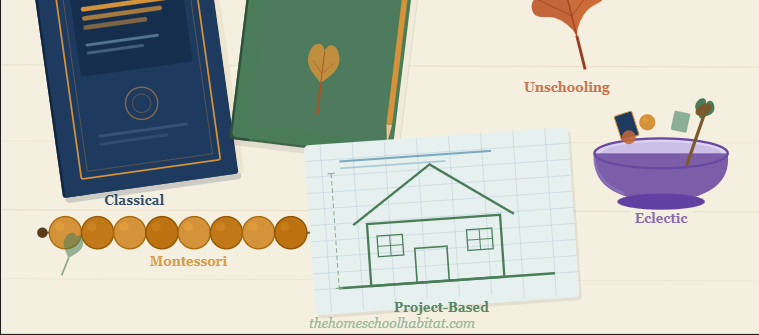
6 Proven Homeschool Methods Compared: Classical, Charlotte Mason, Unschooling, Montessori, Project-Based & Eclectic
Every homeschool family eventually reaches the same moment: you’ve decided to homeschool, you’ve sorted out the legal side, and now you’re staring at what feels like a thousand different options — and you have no idea how to choose. Enter all Homeschool Methods compared.
Most of the confusion comes from comparing curricula (specific products) before you’ve figured out your method (the philosophy that drives how your child learns). Once you know your method, the curriculum choices narrow down fast.
This guide covers the six most common homeschool methods in depth — what they are, what they look like day to day, who they work best for, what they cost, and which specific curricula fit each one. We cover secular and faith-based options within each method, because both deserve honest coverage.
There is no universally right method. There is only the one that fits your child, your family, and your season of life.
📌 How to Use This Guide
Read the homeschool methods profiles in order, or jump directly to the one that sounds most like you. If you finish reading and still feel uncertain — that’s normal. Most experienced homeschoolers describe themselves as ‘eclectic’ because they’ve pulled from several methods over time. The goal is to give you language and landmarks, not a box.
The Quick Comparison
Before the deep dives — here’s a side-by-side overview of all six Homeschool Methods. Use this as your reference anchor as you read.
|
© The Homeschool Habitat |
Classical |
CharlotteMason |
Unschooling |
Montessori |
ProjectBased |
Eclectic/DIY |
|
Structure |
High — daily schedules, formal lessons, scope & sequence |
Moderate — regular habits but gentle pacing |
None — fully child-led |
Moderate — prepared environment, child chooses activity |
Low-moderate — project frames content, child explores |
You decide — as structured or free as you want |
|
Teacher role |
Instructor — you teach, explain, assess |
Guide — you read aloud, narrate, observe |
Facilitator — you provide resources and follow curiosity |
Environment designer — you set up, child works independently |
Collaborator — you design projects, learn alongside |
Whatever works — shifts by subject and child |
|
Primary medium |
Textbooks, recitation, grammar drills, Socratic discussion |
Living books, nature journals, narration, handicrafts |
Real life, play, interests, conversation, experience |
Hands-on materials (manipulatives), self-correcting tools |
Real-world challenges, research, building, presenting |
Mix of everything above |
|
Assessment |
Tests, recitation, formal evaluation |
Narration, observation, portfolio |
Portfolio of experiences, no formal testing |
Observation, self-correction built into materials |
Project presentations, documentation, reflection |
Whatever feels right for the child |
|
Cost range |
$500–$3,000+/year |
$0–$800/year |
$0–varies (experiences, materials) |
$200–$2,000+/year |
$0–$500/year (materials + projects) |
Varies — you pick the pieces |
|
Faith-based options |
Yes — many (Classical Conversations, Veritas, etc.) |
Yes — Simply Charlotte Mason, Ambleside Online |
Not curriculum-based — any worldview |
Some — mostly secular/inclusive |
Mostly secular — worldview-neutral by nature |
Yes — you mix as you choose |
|
Secular options |
Some — Classical Academic Press, Memoria Press |
Yes — Ambleside Online (free) |
Yes — no curriculum needed |
Yes — many Montessori materials secular |
Yes — most PBL resources are secular |
Yes — you choose the pieces |
|
Best ages |
K–12 (grammar K-6, logic 7-9, rhetoric 10-12) |
K–12 (especially strong K-8) |
Any age — philosophy, not a method |
Birth–12 (strongest in ages 2-9) |
K–12 (especially strong 8+) |
K–12 |
|
Ideal learner |
Loves language, debate, structured challenge |
Imaginative, loves stories, nature, gentle pace |
Self-directed, passionate, resists structure |
Hands-on, independent, sensory learner |
Curious, project-minded, social learner |
Multiple learning styles in one household |
💡 Tip
Print this table or save this page. As you read deeper into each method, you’ll find yourself coming back to it to compare specific rows.
📜 Classical Education
The method of the ancient world — logic, language, and the Western tradition.
The core idea:
Classical education is built on the Trivium — three stages of learning that mirror child development. The Grammar Stage (roughly K-6) focuses on absorbing foundational knowledge through memory, repetition, and recitation. The Logic Stage (grades 7-9) trains students to think critically, identify fallacies, and argue systematically. The Rhetoric Stage (grades 10-12) teaches students to express their ideas persuasively and beautifully. The goal is not just to fill a child with knowledge, but to produce a student who can think.
What it looks like day to day:
- Daily recitation — memory work, grammar rules, history timelines, math facts
- Heavy reading in original or classic sources (primary texts, not textbook summaries)
- Writing instruction that progresses from copywork → narration → composition → rhetoric
- Latin instruction (common but not universal across all classical programs)
- Socratic discussion and formal debate in the Logic and Rhetoric stages
- History taught chronologically — ancient, medieval, early modern, modern — on a 4-year rotation
Who thrives here:
Children who love language, argument, and being taken seriously intellectually. Kids who enjoy memorization and thrive with structure. Families who value a rigorous, literature-saturated education rooted in the Western tradition. Classical is NOT a gentle method — it is demanding by design.
Who might struggle:
Highly kinesthetic learners who need to move. Children who shut down under academic pressure. Families who want a relaxed, child-led environment. Classical can feel relentless if the fit isn’t right.
Cost:
$0–$3,000+ per year depending on program and materials. Classical curricula tend to be on the higher end because of the volume of books and materials involved.
Classical Curriculum Homeschool Method Picks
[Classical — Faith-Based]
💰 Cost: $1,000+/year + community tuition
🎯 Best for: Families wanting classical education with a built-in weekly community
CC is as much a community as a curriculum — families meet weekly in local ‘communities’ to recite memory work together across history, science, math, and Latin. Three stages follow the Trivium precisely. One of the most popular classical programs in the country, and one of the few with a robust in-person community component. The built-in co-op is a major draw for families who want both rigor and connection.
[Classical — Faith-Based]
💰 Cost: $500–$2,500+/year
🎯 Best for: Families wanting rigorous classical academics with online live class options
Veritas Press offers one of the most academically rigorous classical Christian programs available, including self-paced and live online class options. Strong in history and literature. History is organized chronologically using their 5-epoch model. Well-suited to motivated, academically-driven students.
[Classical — Secular]
💰 Cost: $40–$200/subject
🎯 Best for: Secular or mixed families wanting individual classical subjects
Classical Academic Press offers individual subject materials — Latin, logic, writing, rhetoric — without requiring you to adopt an entire faith-integrated program. One of the few fully secular classical publishers. Strong in Latin (Song of the Ancients) and informal logic. Great for eclectic families who want to add classical elements to an existing program.
[Classical — Faith-Based]
💰 Cost: $300–$1,500+/year
🎯 Best for: Families wanting traditional classical structure with gentle faith integration
Memoria Press offers a comprehensive classical program with light faith integration — less explicitly Christian than Classical Conversations or Veritas. Strong in Latin, literature, and the Great Books tradition. One of the more affordable complete classical programs when purchased as individual subjects.
[Classical — Secular]
💰 Cost: Book: ~$40 & curriculum costs
🎯 Best for: Secular families building a custom classical program
The Well-Trained Mind is not a curriculum but a comprehensive guide to building your own classical education from existing resources. It is the secular classical bible — Susan Wise Bauer’s masterwork that outlines the full K-12 classical path using primarily secular materials. If you want classical without the faith integration, start here.
🌿 Charlotte Mason
Education as the science of relations — living books, nature, and the whole child.
The core idea:
Charlotte Mason was a 19th-century British educator who believed that children are born persons — not empty vessels to be filled, but full human beings deserving of a rich, living education. Her method centers on three things: living books (beautifully written narratives by real authors, not textbook summaries), narration (the child retells what they’ve learned, building comprehension and memory), and nature study (regular, attentive time outdoors developing observation skills). The goal is a deep, unhurried relationship with ideas, people, and the natural world.
What it looks like day to day:
- Morning reading time — 15-20 minutes per subject, rotating through living books across history, science, and literature
- Narration after each reading — the child tells back what they heard in their own words (oral for young children, written for older)
- Nature journals — regular outdoor time with sketching, observation, and seasonal recording
- Copywork and dictation — handwriting and spelling developed through beautiful passages, not worksheets
- Handicrafts — practical skills like knitting, woodwork, or cooking built into the weekly schedule
- Short lessons — CM believed in focused, short sessions (15-20 min) with frequent breaks, especially for younger children
Who thrives here:
Children who love stories, nature, and imaginative play. Families who want a gentle but intellectually rich environment. Parents drawn to a slower pace of learning that honors childhood. CM is often described as the method that feels most like a beautiful childhood — unhurried, meaningful, and full of real things.
Who might struggle:
Children who need explicit, structured skill instruction (especially in math and phonics). Highly analytical learners who want direct answers rather than discovery. Families who need a packaged, all-in-one system with clear daily instructions.
Cost:
$0–$800/year. Charlotte Mason is one of the most budget-friendly methods because it relies heavily on library books, nature, and free online resources. Ambleside Online is entirely free. Paid programs like Simply Charlotte Mason remain affordable relative to structured curricula.
Charlotte Mason Curriculum Homeschool Method Picks
[Charlotte Mason — Secular-friendly / Gentle Christian]
💰 Cost: FREE
🎯 Best for: Families wanting a full Charlotte Mason curriculum at no cost
Ambleside Online is a completely free, comprehensive Charlotte Mason curriculum built by a community of CM educators. It follows Charlotte Mason’s original reading lists with some updates. The books skew toward older British literature and include some Christian content, but it is widely used by both secular and faith-based families. One of the best free homeschool resources in existence.
[Charlotte Mason — Faith-Based]
💰 Cost: $30–$300/year (highly customizable)
🎯 Best for: Families wanting a beautiful, curated CM program with faith woven throughout
Simply Charlotte Mason is one of the most beloved Charlotte Mason publishers — beautifully designed, carefully curated, and flexible. Faith is woven gently throughout rather than being explicit in every lesson. Extremely popular with families across a range of faith expressions. Their free YouTube channel and website are also outstanding resources even if you don’t buy their curriculum.
[Charlotte Mason — Secular]
💰 Cost: $120–$400/year
🎯 Best for: Secular or inclusive families wanting a CM program with no religious content
Wildwood is a secular Charlotte Mason curriculum designed specifically for families who want the full CM experience — living books, narration, nature journals, handicrafts — without any faith integration. One of the cleaner secular CM options available.
[Charlotte Mason — Secular]
💰 Cost: $100–$250/year
🎯 Best for: Secular families with younger children (K-4) wanting a gentle CM start
A Mind in the Light offers secular Charlotte Mason guides for the early years, with carefully selected living books and a gentle, organized approach. A good entry point for secular families new to Charlotte Mason who want a structured but relaxed starting place.
🌀 Unschooling
Radical trust in the learner — life as curriculum, curiosity as the engine.
The core idea:
Unschooling is the belief — rooted in the work of educator John Holt — that children are natural learners, and that compulsory schooling with its grades, tests, and schedules actively interferes with that natural drive. Unschooling families do not use a curriculum. They provide rich environments, respond to their children’s interests, remove obstacles, and trust the process. Learning happens everywhere, all the time, through real life.
What it looks like day to day:
- No set lessons, no scheduled subjects — the day unfolds around what the child is interested in
- Deep dives: a child obsessed with trains may spend months on railway history, engineering, geography, and economics — without a single worksheet
- Parents as resource-connectors — finding mentors, books, places, experiences that feed whatever the child is chasing
- Real-world learning: cooking, building, shopping, gardening, travel, community involvement
- Lots of play — especially for young children, because play IS learning in early childhood
- Documentation for legal compliance — photos, descriptions of activities, reading lists, projects — organized into a portfolio
Who thrives here:
Self-directed children with strong internal motivation. Families who trust deeply in the learning process and can tolerate uncertainty. Parents who are natural resource-connectors and enjoy facilitating rather than instructing. Families with the time and flexibility to follow interest wherever it leads.
Who might struggle:
Children who crave structure and feel anxious without clear expectations. Parents who need a visible plan or measurable progress to feel confident. Families in states with strict assessment requirements (note: SC’s Options 2 and 3 are more unschooling-compatible than Option 1). Unschooling requires deep parental trust — in the child and in the process.
Is unschooling legal in South Carolina?
Yes — with intentional documentation. SC requires coverage of 5 subjects (7 in grades 7-12) and a semiannual progress report under all three legal options. Unschooling families document their children’s natural learning in ways that demonstrate subject coverage — a portfolio of projects, photos, reading logs, and experience descriptions. Many unschooling families in SC operate under Option 3 (50+ member association) which offers more flexibility than Option 1.
Cost:
$0 to whatever you choose to spend on experiences, materials, and memberships. Unschooling can be genuinely free (libraries, nature, community) or can include significant spending on lessons, travel, co-ops, and enrichment.
Unschooling Homeschool Method Resources
Unschooling isn’t curriculum-based, so instead of curriculum picks, here are the key resources for unschooling families:
[Unschooling — Secular]
💰 Cost: $15–$20 per book
🎯 Best for: Every family considering unschooling
The two books that started the modern unschooling movement. Required reading. Holt’s observations of real children learning (and failing to learn) in traditional school environments are the intellectual foundation of everything unschooling is built on.
[Unschooling — Secular]
💰 Cost: ~$15
🎯 Best for: Families wanting the research case for self-directed learning
A developmental psychologist’s evidence-based case for trusting children’s self-directed learning. Gray founded the Alliance for Self-Directed Education. If you need research to feel confident in unschooling, this is your book.
Khan Academy + YouTube
[Unschooling — Secular]
💰 Cost: FREE
🎯 Best for: Unschooling children who want to dive deep into a topic on their own timeline
When an unschooled child decides they want to learn something, Khan Academy and YouTube are often the first places they go. This is self-directed learning in its most modern form — a child watching 40 videos on volcanology because they decided they care about volcanology. It counts.
[Unschooling — Secular]
💰 Cost: ~$30
🎯 Best for: Families in the early stages who want a practical, realistic unschooling guide
One of the most practical unschooling guides available — not philosophical but concrete. Covers what unschooling looks like in practice, how to document it, how to handle skeptical relatives, and how to trust the process when things feel uncertain.
🔢 Montessori
Follow the child — prepared environments, independent work, and the joy of mastery.
The core idea:
Maria Montessori developed her method in the early 1900s through careful observation of how children actually learn. The Montessori method is built on three principles: the prepared environment (a space designed to invite independent exploration), the child-led work cycle (children choose their own materials and work at their own pace), and the role of the teacher as observer rather than instructor. Montessori materials are hands-on, self-correcting, and sequenced from concrete to abstract — a child feels fractions before they calculate them.
What it looks like day to day:
- Morning work period (uninterrupted 2-3 hours for younger children) — child selects their own work from available materials
- Hands-on Montessori materials: golden bead chains for math, sandpaper letters for phonics, bead bars for multiplication
- The three-period lesson: teacher names, child identifies, child recalls — a gentle, non-pressured introduction cycle
- Mixed-age groupings (typically 3-year spans) — younger children learn from older; older children reinforce through teaching
- Self-correction built into materials — the child discovers their own errors without teacher judgment
- Grace and courtesy practice — deliberate social and emotional skill-building woven into daily routines
Who thrives here:
Independent, self-motivated children who prefer to work with their hands. Children who are easily overstimulated by a busy classroom environment. Kinesthetic learners who need to touch and move materials. Young children especially (ages 2-9) — this is where Montessori is most powerful. Children who find traditional worksheets deadening.
Who might struggle:
Children who need a lot of adult interaction and verbal engagement to stay motivated. Older children (10+) where the Montessori material set becomes thinner and more supplementation is needed. Families who find the material cost prohibitive (authentic Montessori materials are expensive, though DIY options exist).
Cost:
$200–$2,000+ per year. Authentic Montessori materials are a significant upfront investment — a full set of primary materials can run $1,000–$3,000+. However, many families DIY materials, buy used, or use digital Montessori resources at a fraction of the cost. Ongoing curriculum guides tend to be less expensive once materials are in place.
Montessori Curriculum Homeschool Method Picks
[Montessori — Secular]
💰 Cost: $200–$600+/year
🎯 Best for: Secular Montessori families wanting comprehensive primary and elementary guides
Keys of the World is one of the most comprehensive secular Montessori curriculum guides available for home use — covering primary (3-6) and elementary (6-12). It bridges authentic Montessori materials with a structured sequence parents can follow at home without formal Montessori training.
[Montessori — Secular-friendly]
💰 Cost: $15–$40/month subscription
🎯 Best for: Families new to Montessori wanting affordable printable activities
Montessori By Mom offers a subscription-based printable library of Montessori activities for home use — accessible, affordable, and designed for parents who didn’t go through Montessori teacher training. A good starting point for families curious about Montessori without the full material investment.
[Montessori — Secular]
💰 Cost: $10–$30/month
🎯 Best for: Secular families wanting online Montessori training and planning guides
Cultivating Dharma offers secular online Montessori education guides and planning resources for homeschool parents. Strong in 3-6 primary content. A good complement to physical Montessori materials.
[Montessori — Catholic/Christian]
💰 Cost: $200–$600+/year
🎯 Best for: Catholic or Christian families wanting Montessori integrated with faith formation
The Catechesis of the Good Shepherd is a Montessori-inspired religious formation program developed by Sofia Cavalletti. While not a full academic curriculum, it is widely used by Catholic homeschool families as the faith component of a Montessori-influenced home education. Often paired with secular Montessori academic materials.
🔧 Project-Based Learning (PBL)
Real problems, real products, real understanding — learning by making and doing.
The core idea:
Project-Based Learning organizes academic content around extended, real-world projects that have a meaningful outcome. Instead of studying the American Revolution through a textbook, a PBL student might research it, debate its causes, write a pamphlet from a colonist’s perspective, and present their argument to an audience. The project IS the curriculum — academic skills (reading, writing, math, science) are embedded in the work of doing something real.
What it looks like day to day:
- A driving question or challenge anchors the project: ‘How could we design a more sustainable school garden?’ or ‘What would life have been like as a child in Colonial Virginia?’
- Research phase: reading, interviewing, watching, experimenting to gather information
- Building phase: writing, making, constructing, coding, cooking — producing something real
- Reflection and revision: reviewing work, getting feedback, improving
- Presentation or publication: sharing the product with a real audience — family, community, or online
- Math and language arts woven in as needed — a cooking project covers fractions; a documentary project covers writing and editing
Who thrives here:
Curious, entrepreneurial children who are energized by making things and solving problems. Children who find traditional academics disconnected from real life and lose motivation quickly. Social learners who enjoy collaboration. Older children and teens especially — PBL scales well into middle and high school.
Who might struggle:
Younger children (under 7) who don’t yet have the sustained focus for extended projects. Children who need explicit, sequential skill instruction (especially early reading and phonics — these typically need to happen separately). Families who need clear daily structure — PBL can feel ambiguous without careful project design.
Cost:
$0–$500/year for materials and resources. PBL is inherently low-cost because the raw material is the world around you. The main investment is time and parent creativity in designing meaningful projects.
Project-Based Learning Homeschool Method Resources
[PBL-friendly — Secular-leaning]
💰 Cost: $300–$900+/year (kit bundles)
🎯 Best for: Families wanting hands-on, project-heavy curriculum kits
Timberdoodle’s annual curriculum kits are built around hands-on, project-rich learning — engineering kits, art projects, science experiments, and creative challenges alongside core academics. One of the best-curated kits for families who want a PBL-influenced approach without building everything from scratch.
[PBL-friendly — Faith-Based]
💰 Cost: $15–$60/unit
🎯 Best for: Faith-based families wanting nature study projects integrated with core content
Good and the Beautiful’s nature study units combine science content with hands-on observation projects, nature journals, and field activities. While not a pure PBL curriculum, the project-based nature study approach makes it a strong complement to any faith-based program.
[PBL-friendly — Secular]
💰 Cost: $10–$100+/class
🎯 Best for: Families wanting live project-based classes with real instructors
Outschool is an online marketplace of live, instructor-led classes covering virtually every subject imaginable — including many explicitly project-based courses in science, engineering, writing, game design, and the arts. Pay per class. A powerful supplement for PBL families who want expert instruction on specific projects.
[Project-Based — Secular]
💰 Cost: $30–$80/level
🎯 Best for: Secular families wanting structured science with strong lab/project components
Elemental Science offers secular science programs built around observation, experimentation, and documentation — an inherently project-based approach. Strong lab component at every level. One of the cleaner secular science options that naturally supports a PBL learning style.
🎨 Eclectic / DIY Homeschooling
The method of most experienced homeschoolers — whatever works, for this child, right now.
The core idea:
Eclectic homeschooling isn’t a method in the philosophical sense — it’s a practice. It’s the recognition that no single method or curriculum perfectly serves every child in every subject at every age, and that a thoughtful parent is better positioned than any publisher to design an education that actually fits their family. Eclectic homeschoolers mix and match: classical structure for history, Charlotte Mason for literature, Khan Academy for math, a Montessori shelf for the youngest, and a semester of project-based learning when the older child needs something different.
What it looks like day to day:
- No single program runs the household — different subjects may use different approaches
- Curriculum changes are allowed (and common) when something isn’t working
- Parent has developed enough literacy in multiple methods to select intelligently
- Seasonal shifts are normal — more structured in fall, more project-based in spring
- Children may be educated differently from each other based on their individual learning styles
- The goal is always the same: what does THIS child need to flourish RIGHT NOW?
Who thrives here:
Almost everyone — eventually. Most experienced homeschool families land here after a few years of experimentation. Eclectic works especially well for families with multiple children who learn very differently, and for parents who are comfortable with flexibility and enjoy curating their own approach.
Who might struggle:
Brand-new families who need the safety of a complete, structured program to start. Parents who are overwhelmed by too many choices — paradox of choice is real, and eclectic requires you to make a lot of decisions. Starting with one clear method for the first year and moving toward eclectic over time is a wise approach.
Our honest recommendation for new families:
Don’t start eclectic. Pick one method, try it for a full year, and learn what works and what doesn’t for your specific child. That experience is what gives eclectic homeschooling its power — you need to know the methods before you can mix them intelligently. After year one, most families naturally start pulling from multiple sources.
Cost:
Entirely variable. Eclectic families are often the most budget-efficient because they buy only what they need and use a lot of free resources alongside targeted paid programs.
Eclectic Curriculum Homeschool Method Picks
Eclectic families build from components. Here are the most commonly used and trusted building blocks:
[Math — Secular]
💰 Cost: $50–$150/level
🎯 Best for: Kinesthetic and visual math learners — any philosophy
Math-U-See uses manipulatives (physical blocks) to build math understanding from concrete to abstract. Works across learning styles and philosophies. One of the most popular standalone math programs for eclectic families because it pairs with almost any other approach.
[Language Arts — Secular]
💰 Cost: $40–$80/level
🎯 Best for: Any family needing structured, explicit phonics instruction
Orton-Gillingham based reading and spelling instruction. Highly structured, multi-sensory, and highly effective — especially for children who struggle with reading or show signs of dyslexia. The most recommended secular reading program in the homeschool community for a reason.
[History — Secular]
💰 Cost: $15–$40/volume
🎯 Best for: Secular families wanting an engaging narrative history spine
Story of the World is a four-volume narrative history of the world from ancient to modern times, written in engaging, accessible prose. The gold-standard secular history spine for K-8. Used widely by classical, Charlotte Mason, eclectic, and even some unschooling families as a history anchor.
[History — Faith-Based]
💰 Cost: $65–$85/volume
🎯 Best for: Faith-based families wanting a biblically framed world history spine
Mystery of History covers world history through a biblical lens across four volumes. A popular faith-based alternative to Story of the World, widely used in classical Christian and Charlotte Mason faith-based programs.
[All Subjects — Secular]
💰 Cost: FREE
🎯 Best for: Any family wanting free, self-paced math and academic content
Used by nearly every eclectic homeschool family in some capacity. Khan Academy’s math sequence is genuinely excellent, and the platform covers history, science, and humanities well enough to serve as a supplement in most subjects. The best free academic resource in existence.
[Writing — Faith-Based]
💰 Cost: $40–$300+/year
🎯 Best for: Families wanting structured, proven writing instruction
IEW is the most widely used writing program in the homeschool world, and for good reason — it works. The structured system (source summaries, key word outlines, dress-ups) produces real writing improvement. Light faith integration. Used heavily by classical and eclectic families who want an explicit writing program regardless of their overall method.
[Writing — Secular]
💰 Cost: $10–$200+/year
🎯 Best for: Secular families wanting a literature-rich, gentle writing program
Brave Writer is a secular writing program built around the idea that writing grows from wide reading and authentic expression — not mechanical drills. Beloved by Charlotte Mason, eclectic, and unschooling-leaning families who want writing to feel meaningful rather than painful.
A Note on Secular vs. Faith-Based Curriculum
Every method above exists in both secular and faith-based versions — or is worldview-neutral by nature (Montessori, PBL). The question of secular vs. faith-based is not a method question; it’s a values question you answer independently of your chosen method.
A few things worth naming:
- Faith-based does not mean academically inferior, and secular does not mean anti-faith. Both produce excellent homeschoolers.
- Most classical curricula lean faith-based because classical education has historically been rooted in the Western Christian tradition. Secular classical options exist but are fewer.
- Charlotte Mason exists in genuinely excellent versions on both sides — Ambleside Online is faith-friendly, Wildwood is secular.
- Montessori, PBL, and eclectic approaches are the most worldview-neutral — you bring your own faith or secular perspective to the method.
- Unschooling is philosophy-agnostic — secular, Christian, and faith-based families all practice it.
📌 Our Philosophy at The Homeschool Habitat
This site is founded by a secular homeschooling mom. It is written for all homeschool families. We cover faith-based curriculum because faith-based families are the majority of the homeschool community and deserve good information.
You will not find a worldview agenda here. The best curriculum is the one that works for your child — and that is true whether you are secular, Christian, Catholic, or anything else.
How to Choose Homeschool Methods
After reading six method profiles, you may feel more clear — or more overwhelmed. Either response is valid. Here is a practical framework:
Step 1: Watch your child for one week before choosing anything.
How does your child learn best right now? Do they love being read to? Do they need to build things? Do they follow one obsession for weeks at a time? Are they calmer with a predictable schedule or do they thrive with open time? Your child’s natural learning style is your most important data point — more important than any method’s marketing copy.
Step 2: Be honest about yourself.
How much structure do YOU need to feel confident? Can you tolerate an unscheduled day without anxiety? Do you love to plan and organize, or does detailed planning feel like a second job? The method has to work for the parent as much as the child. A burned-out homeschool parent is not serving anyone well.
Step 3: Start with one method for one full year.
Pick the method that feels most aligned with Steps 1 and 2. Commit to it for a full school year before evaluating. Six weeks is not enough time to know if a method works — it takes time to build habits, find the rhythm, and see results. Year two is almost always better than year one, regardless of method.
Step 4: Free first.
Before spending money: Khan Academy covers math, Ambleside Online covers Charlotte Mason, library books cover almost everything else. Spend money only after you’ve confirmed the method is working. The homeschool curriculum market runs on the anxiety of new families — don’t let it.
Step 5: Your method will evolve. That’s healthy.
The family that uses the same method identically from kindergarten through high school is the exception. Most families drift toward eclectic over time as they learn what works. This is not failure. It’s wisdom.
🌿 The Hard Learned Truth
The method matters less than the relationship. A mediocre curriculum delivered by a parent who knows their child, reads to them, answers their questions, and shows up every day will out-perform a perfectly designed program delivered by a burned-out parent who bought it because it was expensive and impressive.
Start simple. Stay curious. Give it time.
Frequently Asked Questions
Can I use more than one method?
Yes — and most families eventually do. Using Charlotte Mason for language arts while doing classical history and Khan Academy for math is entirely normal. The goal is serving your child, not methodological purity. That said, starting with one method and learning it well before mixing is generally better than trying to combine everything at once.
Which method is best for kids who struggle with reading?
Regardless of overall method, children who struggle with reading typically need explicit, structured phonics instruction — the kind you find in All About Reading, Logic of English, or other Orton-Gillingham based programs. Charlotte Mason’s copywork and dictation approach works beautifully for children who read fluently, but for children with reading challenges, explicit phonics is usually necessary alongside whatever method you choose. A great source is ‘Teach Your Child to Read in 100 Easy Lessons’ by Siegfried Engelmann.
Is unschooling legal in South Carolina?
Yes, with intentional documentation. SC requires coverage of the five core subjects (plus composition and literature for grades 7-12) and a semiannual progress report. Unschooling families document their children’s learning experiences to demonstrate subject coverage — through portfolios of projects, photos, reading logs, and experience descriptions. Options 2 (SCAIHS) and 3 (50+ member association) are generally more compatible with unschooling than Option 1.
What if my child hates the method I chose?
Change it. This is one of the greatest advantages of homeschooling — you are not locked in. If something isn’t working after a genuine trial (8-12 weeks minimum), pivot. Document what you’ve covered, start fresh, and move on without guilt. The flexibility to respond to your actual child in real time is the whole point.
Which method works best for high school?
Classical, eclectic, and project-based all scale well to high school. Unschooling can work beautifully for motivated teens with strong self-direction. Montessori becomes thinner in high school as the material set is less developed for that age range. Charlotte Mason continues to be excellent for literature-rich humanities work at the high school level. Most high school homeschoolers use an eclectic approach — structured where transcripts require it, flexible where learning is richer that way.
Do colleges care which method we use?
No. Colleges evaluate homeschool applicants on transcripts, standardized test scores, portfolios, and extracurricular involvement — not on which method was used. Unschooled, classical, Montessori, and eclectic graduates all gain admission to competitive colleges every year. What matters is that the student can demonstrate learning — not how that learning happened.
📚 GO DEEPER: Curriculum Reviews
This post is for a homeschool methods overview. For in-depth reviews of specific curricula — with honest pros, cons, and real-family feedback — visit our Curriculum Reviews page.
🎁 FREE DOWNLOAD: New Homeschooler’s Starter Kit
Includes a method comparison worksheet, a ‘what does my child need?’ checklist, and a curated list of free Upstate SC resources — all in one free 8-page PDF.
📬 FIELD NOTES — Our Weekly Newsletter
Curriculum deals, new resource alerts, and real homeschool talk every Thursday at 9am. Free, always.
Sign-up here!

👩💻 AUTHOR BIO
Crystal | Founder, The Homeschool Habitat
Crystal is a homeschooling mom in Upstate South Carolina and founder of The Homeschool Habitat.
She built this site because she remembers exactly how confusing those first Google searches felt — and wanted to create the clear resource she wished she’d had.
Follow @TheHomeschoolHabitat on Pinterest and Facebook.